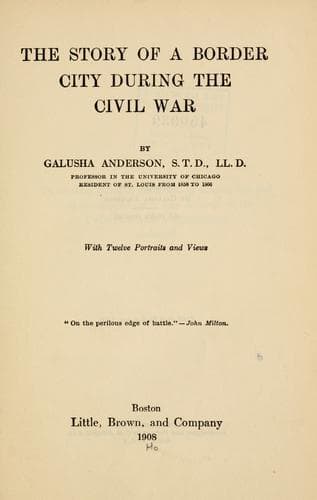
The story of a border city during the Civil WarAnderson, Galusha
History
The story of a border city during the Civil War
Anderson, Galusha
Missouri -- History -- Civil War, 1861-1865; Saint Louis (Mo.) -- History -- Civil War, 1861-1865
tearfully entreated us to buy her, promising over and over again to be
faithful and good. In that sad entreaty one could detect the harrowing
fear of being sold down South. Her plaint was more than a good pastor
from Troy, N. Y., could endure. Coming up close to my side he said, “For
God’s sake, Anderson, let us get out of here!” I rapped on the door; Mr.
Lynch opened it; we thanked him for his kindness, bade him good day, and
marched silently down the street. There was now no joking, no merriment.
We turned the corner into another street. We were hidden from Lynch’s
gaze. My friend from Troy stopped; in indignation he stamped his foot;
he was in agony of spirit; he planted his heel on the brick sidewalk
and, turning the toe of his foot hither and thither again and again, he
ground the brick under his heel. It was an instinctive bodily movement,
an irrepressible outward expression of his intense desire to grind
slavery to powder. At last he exclaimed, “Thank God, I never had
anything to do with that.” “Don’t be too sure about that,” I replied,
“how have you voted? Now,” I added, “let us go to a slave-pen at the
corner of Fifth and Myrtle Streets, where they keep little colored boys
and girls for sale.” “No,” he vehemently replied, “I will not go a step,
I have seen enough. You could not hire me to go there with all the gold
in California.”
This pen where slave children were kept was much larger than Lynch’s.
The traffic in children seemed to be specially brisk and profitable. The
inmates of this grim prison-house were from about five to sixteen years
old. Both sexes were there. When the slave-trader bought a mother and
her children, she was sometimes for a season shut up with her brood in
that hated place. Every few weeks there was an auction of these black
children, with all of its repulsive, heart-breaking scenes. On one such
occasion the auctioneer commended to a crowd a beautiful mulatto girl,
about sixteen years old, as having the blood of a United States senator
running in her veins. Some in that gaping throng listened with delight;
but a gentleman from the East, a mild-mannered man, unexpectedly flamed
out with indignation, and denounced the auctioneer and the whole vile
slave-trade. For this drastic, burning denunciation he was threatened
with violence. But this man of gentle spirit and manners, when aroused,
proved to be a veritable “son of thunder,” and he defied his assailants.
“When,” he said, “this shameless injustice is not only periodically
enacted in our city, but our whole State is plunged into ignominy by
offering for sale a daughter of a United States senator, I cannot and
will not hold my peace. Do what you please. I denounce the outrage.”
Those that threatened him were cowed into silence; the disturbance was
only a momentary ripple; the auctioneer went on with his nefarious task;
the girl with senatorial blood was knocked down to the highest bidder.
And then another, and another, and another, boy or girl, was sold under
Public-domain text, read in full here on John Shaqi.
Reviews
Reviews
No reviews yet
Be the first to share your thoughts on this work.
Elsewhere in the archive
Join the Discussion
Join the discussion
Sign in to leave a comment or review.
Sign InorCreate an account