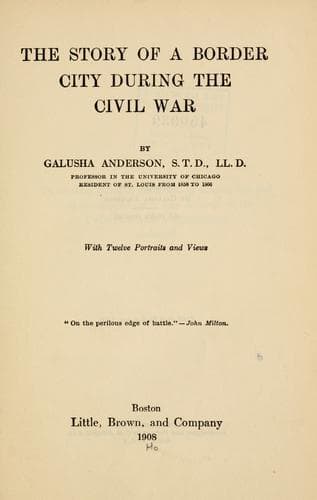
The story of a border city during the Civil WarAnderson, Galusha
History
The story of a border city during the Civil War
Anderson, Galusha
Missouri -- History -- Civil War, 1861-1865; Saint Louis (Mo.) -- History -- Civil War, 1861-1865
This case was a type of many others. Some young men, among the hundreds
of thousands that enlisted in the Northern and Southern armies, failed
adequately to count the cost of what they so enthusiastically undertook
to do. Two young men of St. Louis, who enlisted in the Confederate army,
were doing duty under Price, in Missouri. November had come with its
chilling storms of rain and sleet; and without a tent they were
compelled to spend a night in the shelterless field. They had gathered
some logs and sticks and were endeavoring, as the gusts of wind swept
over them, to light a fire; but their kindling was wet and the wind
would quickly blow out their matches. Shivering with cold that seemed to
pierce to the very marrow of their bones, looking in blank despair on
those wet sticks and logs, one of them said: “Joe, soldiering is not
what it is cracked up to be. It is just hell, and I am going to get out
of it as soon as I can.” Still he was an ardent Southerner, but just for
a little his burning zeal was damped and cooled by a chill November
rain.
But my chief experiences were with Confederate prisoners. While the
disloyal of my own denomination abhorred my politics and exercised at
best a rather strained and attenuated brotherly love towards me, when,
for any cause, they were so unfortunate as to get into prison, they
often urgently appealed to me for succor.
Out on the Gravois road, a few miles west of the city, lived a Baptist
preacher. He had sandy hair, a florid face, a muscular frame, and was
about six feet in height. While rough in his manners, he was a man of
great force. Brought up, or as he said, “raised,” in Mississippi, he was
an uncompromising rebel. Late in the autumn of 1861, up in the State, at
the town of Mexico, in a dark night, he swiftly rode on horseback
through the lines of the Federal troops stationed there, and as he did
so holloed: “Hurrah for Jeff Davis.” He was tracked to his home and
arrested. He appeared at my door about nine o’clock in the morning, in a
buggy, sitting between two United States officers. One of them rang my
bell and I went out to see their prisoner. While he heartily despised me
for my loyalty, he had evidently concluded that I was just the man to
help him in his dire extremity. I asked the officers on what charge he
had been arrested. They said that they had not been informed. I then
asked him the same question, and he said that he did not know. He told
no lie, but at the same time he could have very accurately guessed.
Still, he could not have been reasonably expected to incriminate himself
before the officers who had him in charge. He blubbered over his sad
plight and entreated me to intercede with the provost marshal on his
behalf. His tears, however, were not on account of his misdemeanor; he
evidently cried because he had been caught. Nevertheless, I told him
that I would do what I could for him.
Public-domain text, read in full here on John Shaqi.
Reviews
Reviews
No reviews yet
Be the first to share your thoughts on this work.
Elsewhere in the archive
Join the Discussion
Join the discussion
Sign in to leave a comment or review.
Sign InorCreate an account