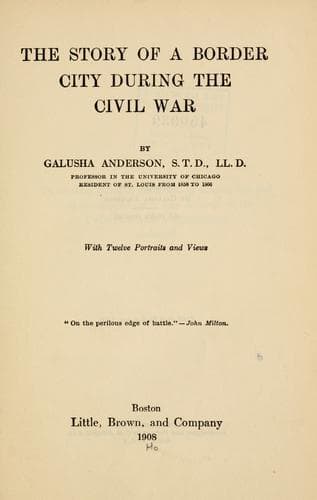
The story of a border city during the Civil WarAnderson, Galusha
History
The story of a border city during the Civil War
Anderson, Galusha
Missouri -- History -- Civil War, 1861-1865; Saint Louis (Mo.) -- History -- Civil War, 1861-1865
A heavy damp snow was falling fast. I had to go on foot through it fully
a mile and a half to intercede for this enemy of my country; while he
rode to his prison-house in a buggy at the government’s expense. On my
way I met one of my deacons, a physician. He was by birth a Kentuckian,
but staunchly loyal. Thinking that I had no right to expose myself to
that pitiless storm, he asked me in peremptory tones where I was going.
I told him. He then wished to know what offence the imprisoned preacher
had committed. I replied that I did not certainly know, but a report was
abroad that he had ridden in a dark night through the picket line of the
Federal army at Mexico, and, having been called upon to halt, had put
spurs to his horse, and had holloed as he rode at breakneck speed to
elude the musket-balls of the soldiers, “Hurrah for Jeff Davis!” The
deacon cried out in indignation, “You go home out of this storm and let
him sweat.” But I could not break my word to the prisoner, so I trudged
on, saw the provost marshal, and pleaded as earnestly as I could for my
incarcerated brother. He said that he would grant me anything that I
might ask within the bounds of reason, but on account of the imperative
demands upon him, he could not try the prisoner until the next day.
Having done my best at the office of the provost marshal, I walked a
mile through the damp snow, that was still copiously falling, to the
prison at the corner of Fifth and Myrtle Streets, to make known to my
rebel neighbor the result of my effort on his behalf. When I told him
that his case could not be heard till the next day, he said in a
disappointed tone: “Then, I must stay here all night,—it is a horrible
place.” “Yes,” I quickly replied, “it is a slave-pen.” His eyes filled
with tears as he said, “I never sold a slave.” His reply made me regret
the thrust that I had inconsiderately given him. But in a moment he
added, “I wish that I had some apples and tobacco.” Though I did not use
tobacco myself I went through the storm about a mile, purchased for him
out of my own pocket the desired articles, carried them back to him, and
giving him my best wishes, I bade him good day, leaving him in that old
slave-pen to his tobacco, apples and thoughts.
The next morning he was brought before the Military court, which having
heard his case, through its great leniency decided, in spite of his
grave offence, to discharge him. Returning to his home he had to go by
my door; but he did not call to thank me for what I had done on his
behalf; neither did he write me, nor did he ever in any way express the
slightest gratitude or appreciation of what I did for him on that stormy
day in order to secure his deliverance from the slave-pen prison.
Public-domain text, read in full here on John Shaqi.
Reviews
Reviews
No reviews yet
Be the first to share your thoughts on this work.
Elsewhere in the archive
Join the Discussion
Join the discussion
Sign in to leave a comment or review.
Sign InorCreate an account