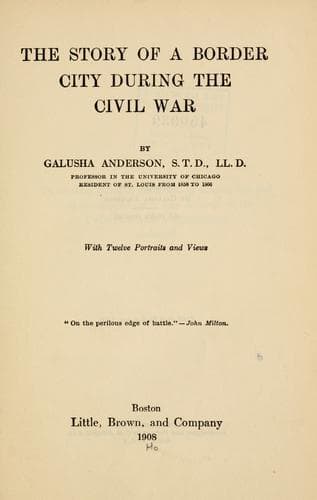
The story of a border city during the Civil WarAnderson, Galusha
History
The story of a border city during the Civil War
Anderson, Galusha
Missouri -- History -- Civil War, 1861-1865; Saint Louis (Mo.) -- History -- Civil War, 1861-1865
And during all this pageant of mourning our hearts bled afresh, as we
remembered that the ear of Fremont had been apparently deaf to Lyon when
he pleaded for at least one more regiment of troops, and was left
unaided to fight, against great odds, a forlorn and desperate battle in
which he laid down his life. We knew then, as we know now, that Fremont
could have granted the request of his subordinate; that General Pope had
in the northern part of the State an army of fully nine thousand men
that were not just then imperatively needed there; that Fremont called
for and put under his own immediate command a part of that force; that
he sent troops at that time into different parts of the State; that two
regiments were guarding Rolla, and that one of them, without
jeopardizing any important interest, could have been sent to Lyon; but
for some occult reason he refused to lift a finger in time to help his
capable subordinate, but abandoned him to defeat and death. To be sure,
on August 5th, he ordered a regiment of a thousand men at Fort
Leavenworth to re-enforce Lyon,[53] but that was too late. There was no
railroad connection. The order had to be sent by express. Before the
regiment had gotten half way to Springfield the fate of Lyon was sealed.
On the same date, August 5th, he ordered Colonel Stevenson, commanding
the Seventh Missouri Volunteers, to report to Lyon with despatch. When
the colonel reached Rolla, he found no transportation for his troops.
They could not reach their destination in time. The remembrance of this
on that funeral march rankled in every loyal heart.
But when our general reported to the War Department the battle of
Wilson’s Creek, in just and fitting words he eulogized the slain hero.
In a measure that dulled the edge of our resentment towards him, and
partially revived our wavering confidence in him. We were still further
reconciled to him, when, seeing the anarchy by which we were threatened,
and believing that certain inimical movements among us could not be
adequately and decisively dealt with by ordinary civil processes, on
August 14th, he declared martial law in St. Louis and St. Louis County.
At that time, according to the most conservative estimate, there were in
our city at least eight thousand pronounced and active secessionists,
and seven thousand of them were reported to be armed with weapons of
various kinds.[54] They were prepared, whenever their compatriots in
rebellion should attack the city from without, to join hands with them
by a vigorous movement from within. So while the necessity of martial
law was regretted by all, its proclamation came as a distinct relief and
assurance to all the loyal.
Public-domain text, read in full here on John Shaqi.
Reviews
Reviews
No reviews yet
Be the first to share your thoughts on this work.
Elsewhere in the archive
Join the Discussion
Join the discussion
Sign in to leave a comment or review.
Sign InorCreate an account