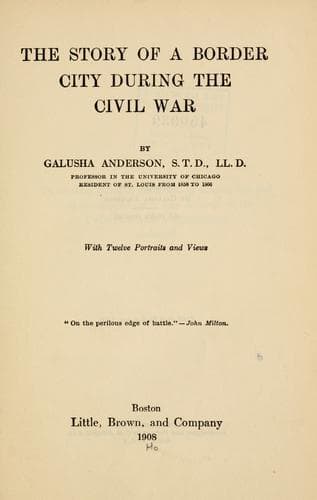
The story of a border city during the Civil WarAnderson, Galusha
History
The story of a border city during the Civil War
Anderson, Galusha
Missouri -- History -- Civil War, 1861-1865; Saint Louis (Mo.) -- History -- Civil War, 1861-1865
The next morning before sunrise, the 10th of August, he vigorously
attacked the enemy, who were taken utterly by surprise. It is not within
the scope of my purpose to attempt any description of the fierce and
bloody battle that followed. It raged for fully six hours. According to
the most conservative estimates, Lyon lost of his small army of four or
five thousand men more than thirteen hundred in killed, wounded, and
missing. The Confederates lost still more. Lyon was twice wounded, and
afterwards, while leading a regiment of his troops in a desperate
charge, was shot through the heart and instantly killed; but even after
his death his plucky little army fought on for a time unflinchingly, and
with a large measure of success. Nor did they abandon the well-contested
field until the ammunition of a large part of their force was utterly
exhausted. Even then they retreated in good order. They had inflicted a
blow so terrible and unexpected that the Confederates were unwilling or
unable to pursue them. Having rested a few hours at Springfield, they
retreated unmolested to Rolla, with all their wagons, provisions, and
munitions of war; while McCulloch and Price sat down at Springfield and
wrote reports of their great victory at Wilson’s Creek. Some of their
subordinate officers in their reports declared with refreshing frankness
that Lyon, in his attack on their camp, had completely surprised them.
A few days later came the last act of this sad drama. The body of
General Lyon was brought back to us. It was borne through the city and
across the Mississippi to the railroad depot. It was escorted by
prominent citizens, city officials, regiments of soldiers, infantry,
cavalry and artillery, marching with arms reversed. Conspicuous in this
martial array was General Fremont, with his staff and body-guard. The
bands played plaintive dirges. The bells tolled. The national flags of
the city, encampments and Arsenal were draped and at half-mast. A great,
sad, silent throng, on either side of the street along which the funeral
cortège moved, stood with heads uncovered. The dust of one of the best
friends the loyal of St. Louis ever had thus passed on its way to burial
in Connecticut, the native State of the dauntless hero, who poured out
his heart’s blood at Wilson’s Creek to save our commonwealth and city
from secession. But strange as it may seem to the present generation, we
were then and there so utterly divided in judgment and feeling that
while many mourned, some rejoiced; tears stained some cheeks, smiles
rippled across some faces.
Public-domain text, read in full here on John Shaqi.
Reviews
Reviews
No reviews yet
Be the first to share your thoughts on this work.
Elsewhere in the archive
Join the Discussion
Join the discussion
Sign in to leave a comment or review.
Sign InorCreate an account