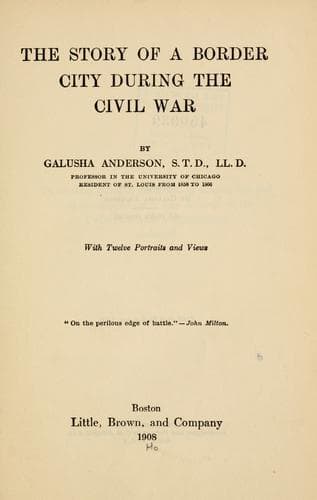
The story of a border city during the Civil WarAnderson, Galusha
History
The story of a border city during the Civil War
Anderson, Galusha
Missouri -- History -- Civil War, 1861-1865; Saint Louis (Mo.) -- History -- Civil War, 1861-1865
But such a statement of the grand result of this campaign gives no
adequate idea of the general condition of the State at that time. There
was great confusion throughout all our borders. Confederate troops,
coming up from Arkansas, invaded at different points our sacred,
sovereign soil. They came to strengthen the hands of the disloyal.
Federal soldiers, in detached bands, were endeavoring to defend the
loyal. There was a skirmish here, a conflict there. State Guards and
Home Guards were in frequent collision. Guerrillas, riding swiftly,
suddenly struck unsuspecting neighborhoods and left behind them dying
men and flaming dwellings. Bushwhackers, hiding in thickets or behind
stone walls, coolly shot down many of the best men of our State. Small
towns often changed hands, one week controlled by Confederates, the next
by Federals. Halleck, as well as he could, kept all his subordinate
officers, in these harried and disordered districts, under his eye. His
orders addressed to them flew thick and fast.
These military movements, that we have briefly noted, were of vast
importance to us. Our destiny hung upon the turn that they took. Hence
they gave us much anxious thought. But while they were transpiring, we
were stirred up by startling and significant events within our gates.
Foremost among the suggestive incidents that agitated our city was the
hand that Halleck took in the negro question. But unlike his predecessor
in command, he kept, in what he did, strictly within the limits of his
authority as a military officer.
Sixteen fugitive slaves had been thrown into the county jail. They were
shut up there, not because they had committed crime, but because that
prison was a convenient place to keep securely such lively
property,—property that did some thinking, had some ardent desires for
freedom, and was blessed with legs. In the latter part of December,
1861, these slaves were advertised for sale, under State laws. The
general, satisfied that they were the property of rebels, ordered the
provost marshal to take them from jail, turn them over to the chief
quartermaster, who was instructed to put them to work for the Federal
government.[86] The general, however, declared that by his order he did
not contravene any civil enactment, by which they might be legally
turned over to their masters. Nevertheless, to their great joy, his move
on their behalf made them virtually free. They became the servants of
Uncle Sam, a kind and gracious master that fully recognized their
manhood. This unexpected act of our general set wagging the tongues of
both secessionists and Unionists, the former sharply condemning, the
latter warmly applauding. There was very bitter war, waged by tongues on
the streets, in the marts of trade and in the parlor, as well as with
Minie balls, solid shot and shell in the field.
Public-domain text, read in full here on John Shaqi.
Reviews
Reviews
No reviews yet
Be the first to share your thoughts on this work.
Elsewhere in the archive
Join the Discussion
Join the discussion
Sign in to leave a comment or review.
Sign InorCreate an account