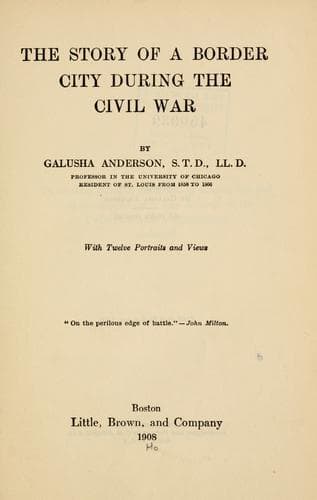
The story of a border city during the Civil WarAnderson, Galusha
History
The story of a border city during the Civil War
Anderson, Galusha
Missouri -- History -- Civil War, 1861-1865; Saint Louis (Mo.) -- History -- Civil War, 1861-1865
Moreover, every important military movement within the bounds of his
department received his thoughtful critical attention. At this time,
General Price had returned to the State and was leading his army
northward. He wished to destroy the Hannibal and St. Joseph Railroad,
and so cut off communication between that part of the State and St.
Louis. He also desired to secure recruits for his depleted ranks from
the northern counties, especially notorious for their disloyalty. Many
of the people of that region hailed his approach and flocked to his
standard. But aside from those who enlisted in his army there were
various companies of secessionists, that enthusiastically entered into
the work of destroying the railroad. At several different points they
tore up the tracks, bent the rails, burned depots and bridges, and
demolished telegraph-poles. This was a serious blow to us, and men in
our city were anxiously asking to what this would lead. But General
Halleck was equal to the situation. He regarded such irresponsible bands
of rebels, engaged in the wanton destruction of public property, as mere
outlaws, having no claim to the immunities accorded to regularly
enlisted soldiers. To meet the exigency he ordered that these lawless
bridge-burners be forthwith arrested and shot. Scores of them were
apprehended; the ringleaders were court-martialed, condemned to be shot,
and were long kept in prison awaiting the execution of the sentence,
which was afterwards commuted to a period of hard labor.
He also followed up the first manifesto by a second, in which he ordered
that, where railroad property had been destroyed, the commanding officer
nearest to the scene of devastation should impress the slaves of all
secessionists in that neighborhood, and, if need be, also the owners of
them, and compel them to do all the menial work required in repairing
the damage that had been done. This order was faithfully carried out,
and it put an end to the destruction of railroad property in that part
of the State. It was a great comfort to us in St. Louis to see that the
orders of our general were not mere fulminations, but the immediate
precursors of deeds; that they hit hard the things aimed at.
But while he put a stop to the destruction of railroad property, he also
organized an effective military campaign before which the ever cautious
Price retreated, with his re-enforced army, into the southwest part of
the State and finally into Arkansas.
Public-domain text, read in full here on John Shaqi.
Reviews
Reviews
No reviews yet
Be the first to share your thoughts on this work.
Elsewhere in the archive
Join the Discussion
Join the discussion
Sign in to leave a comment or review.
Sign InorCreate an account