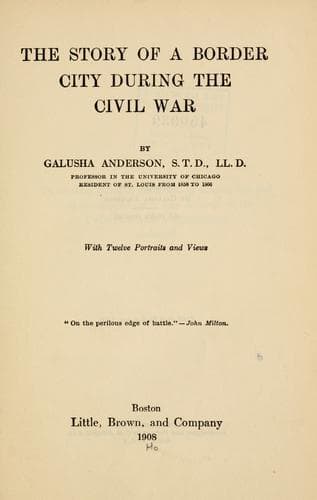
The story of a border city during the Civil WarAnderson, Galusha
History
The story of a border city during the Civil War
Anderson, Galusha
Missouri -- History -- Civil War, 1861-1865; Saint Louis (Mo.) -- History -- Civil War, 1861-1865
But while in tatters and gaunt with hunger, most of them were utterly
unwilling to work. They regarded manual labor as a disgrace. They had
been taught in the school of slavery that honest toil was servile and
ignoble. The notion quite generally prevailed among them that since they
had fled from rebeldom, the government was under obligation to feed and
clothe them, while they sat down in idleness and glumly received its
gifts. What charity added to government supplies they thoughtlessly
consumed, and then stretched out empty, thriftless hands for more.
An incident or two will present in concrete form their aristocratic
notions concerning labor. James E. Yeatman, President of the Western
Sanitary Commission, became deeply interested in a girl of sixteen,
belonging to a refugee family from Arkansas. With considerable personal
effort he secured for her the position of nurse-girl in a household
where her highest good, in every way, would have been sought. Rejoicing
in doing a benevolent deed, though a very busy man, with great
responsibilities weighing on mind and heart, he drove more than two
miles to apprise her mother of his success. The family were living on
government rations, and every article of their dress showed their
extreme poverty; but the mother met this offer of a place for her
half-starved child by exclaiming: “W’at, my darter a sarvant and work
like a niggah! no, sah! she’ll rot fust!” “Very well, madam,” with
righteous indignation replied Mr. Yeatman, “let her rot;” and jumping
into his buggy, drove hurriedly back to his office in the city.
I visited a family of this class at the Virginia Hotel, an old hostelry,
which was used as an asylum for freedmen and white refugees. The room
adjoining one occupied by a family of refugees had been assigned to a
negro. These refugees were clothed in rags and were barefooted. The
unkempt hair of the wife and mother was a mass of matted tangles. In
their cheerless apartment there was neither stove nor bed. They slept on
straw and ate from the hand of charity. While I was taking in the
situation and speaking an encouraging word, a benevolent lady stepped in
to relieve their pressing wants, but, strange to tell, found their pride
sorely mortified, not by their personal appearance nor by the litter and
filth in which they were living, but because there was a negro in the
next room. The mother voiced the complaint of that poverty-stricken
household, by saying, in a peculiar drawl: “I say now, we’uns doan think
that ah sooperintend ort to put that niggah in thah; we’uns doan like
that ah purty wal.”
Public-domain text, read in full here on John Shaqi.
Reviews
Reviews
No reviews yet
Be the first to share your thoughts on this work.
Elsewhere in the archive
Join the Discussion
Join the discussion
Sign in to leave a comment or review.
Sign InorCreate an account