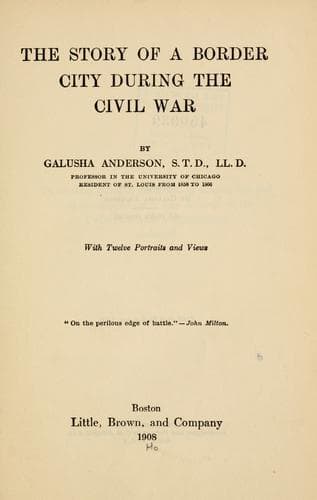
The story of a border city during the Civil WarAnderson, Galusha
History
The story of a border city during the Civil War
Anderson, Galusha
Missouri -- History -- Civil War, 1861-1865; Saint Louis (Mo.) -- History -- Civil War, 1861-1865
I stepped into the adjoining apartment that I might see what had so
offended these aristocratic paupers, and found that the negro, a
contraband or fugitive from bondage, had entered his room at the same
time that the white refugees had entered theirs. But he had found an old
broom and had swept his room, an old stove and had put it up; had
gathered some soft coal to burn in it; had gotten somewhere a rickety
bedstead and set it up and had put on it a tick filled with straw. He
had procured a wash-basin, a cracked looking-glass, and something to
eat. While his room was bare and poor enough, he had made it look in
some measure homelike. At all events he greatly distanced his squalid
white neighbors, who felt degraded by his presence.
Most of the white refugees were illiterates. Their ignorance was so
dense that we are in no danger of exaggerating it. I once sat down by
the side of a sick boy of this class, who lay on a dirty blanket spread
on the floor. His mother, also ill, lay near him. She was afraid that he
would die. They had fled from Batesville, Arkansas, and exposure to cold
and rain, while on their journey, had brought on fever. She could not
read and knew very little of the world outside of the neighborhood
where, up to that time, she had spent her life. Her sick son was fifteen
years old. She wished me to talk with him, which I was glad to do. I
told him of Christ, who came into the world to save sinners, and was
ready to save him. He listened eagerly, but soon said: “If you mean by
sin _cussin_, I never done that.” When I told him of Jesus he looked
intently into my face, and said: “I never heard of him before.” I felt
myself to be a real missionary, sent to tell one poor, sick boy, a
stranger in a strange city, of the Saviour, who then and there was ready
to receive him as his child. But these cases were not rare among poor
whites. The few that could read formed the exceptional class.
Moreover, a large part of them were discouraged, downhearted, often
utterly hopeless. Very many of them also were ill. For a considerable
period about fifty per cent. of the poor white refugees, when they
reached our city, were sent to hospitals. It was extremely difficult to
care for them. Unaccustomed to the ordinary comforts of intelligent and
thrifty communities, they had little or no appreciation of the things
offered to them by the benevolent to alleviate their sufferings. The
delicacies usually so highly prized by the sick were manifestly
repulsive to many of them. Some Christian women, anxious to do what they
could to help and cheer them, carried to the hospital preserved fruits
and jellies. Rejoicing in doing good to those in distress, they
personally offered them these tempting delicacies, prepared by their own
hands. But the wretched sufferers, having never seen nor tasted such
food, said to the angels of mercy that urged them to partake, “We’uns
don’t want that ah; bring us clabber and cawn cakes, that’s what we’uns
like.”
Public-domain text, read in full here on John Shaqi.
Reviews
Reviews
No reviews yet
Be the first to share your thoughts on this work.
Elsewhere in the archive
Join the Discussion
Join the discussion
Sign in to leave a comment or review.
Sign InorCreate an account