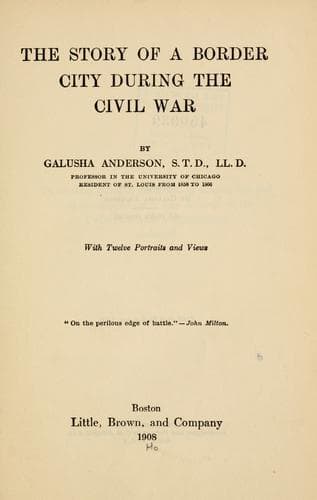
The story of a border city during the Civil WarAnderson, Galusha
History
The story of a border city during the Civil War
Anderson, Galusha
Missouri -- History -- Civil War, 1861-1865; Saint Louis (Mo.) -- History -- Civil War, 1861-1865
There were also many among them who were improvident and wasteful. Still
some of this class were teachable. I remember a widow with three little
daughters who came up from Arkansas. She had there some real estate, but
being a Unionist, she had been compelled by the violence of her
secession neighbors to leave in hot haste. Having had neither time nor
opportunity to convert her holdings into money, on her arrival in St.
Louis, she found herself in want, and was forced, for a time, to depend
on charity for the bare necessities of life. She could neither read nor
write, but was a sincere Christian, and anxious to do her best. She and
her children were decent in appearance. She united with my church and as
often as she could attended the public services. The good women of my
congregation took her under their care and generously provided for her.
Among other things they gave her a boiled ham, and were greatly
disheartened by finding, two or three days after, that when she and her
children had eaten a part of it, she had thrown the rest of it out of
the window. In the heat of the moment they declared that they would
never help her any more. But I pleaded for her. I told them that what
seemed to them inexcusable wastefulness was simply her habit of life,
and that they must talk kindly with her about it, and if possible, lead
her to live reasonably and economically. They did so. She received their
instructions with hearty thanks, declaring that she had done only what
she had been accustomed to do at her home in Arkansas, but that she
would now act according to their wishes and directions. Soon there was
manifest improvement in her humble home, and in the personal appearance
of herself and her little daughters. She sent them to the public school.
They soon learned to read. Great was her joy when they could read to her
their Sunday-school books and the New Testament. At the close of the war
she sold her property in Arkansas, and bought a place a few miles from
St. Louis in Illinois. The last time I saw her was at the depot, across
the river, whither she had gone with her children, to take the cars for
her new home. They were plainly but neatly dressed. They had been
transformed by the patient, kindly work of intelligent Christian women.
They had found a new life and were radiant with joy. So to me, the
curtain fell on that scene. With renewed confidence I went back to the
city and to my labors, feeling how richly it paid to work for poor white
refugees.
Public-domain text, read in full here on John Shaqi.
Reviews
Reviews
No reviews yet
Be the first to share your thoughts on this work.
Elsewhere in the archive
Join the Discussion
Join the discussion
Sign in to leave a comment or review.
Sign InorCreate an account