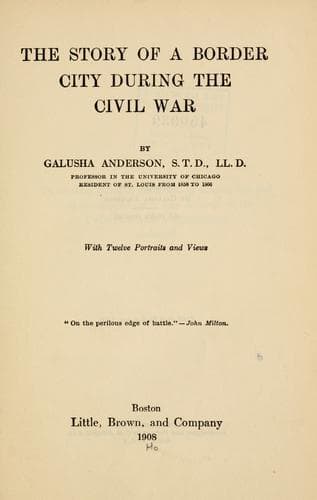
The story of a border city during the Civil WarAnderson, Galusha
History
The story of a border city during the Civil War
Anderson, Galusha
Missouri -- History -- Civil War, 1861-1865; Saint Louis (Mo.) -- History -- Civil War, 1861-1865
But the greatness of their number appalled us. During the war nearly
forty thousand entered our gates. To care adequately and
discriminatingly for such a multitude, many of whom, as we have already
seen, were densely ignorant and averse to honest toil, was a task too
vast for a city of not more than a hundred and fifty-two thousand
inhabitants. So in this, as in every great need engendered by the war,
the Federal government, through its military officers, lent a strong,
helping hand; while the Sanitary Commission, whose work we propose to
set forth in a subsequent chapter, took a leading part in this great and
urgent charity. Through this triune agency, among many projects
inaugurated to meet the wants of the refugees, a six-story building, the
precursor of several others of like character, was fitted up for their
accommodation. Into it a thousand of them were put. Here they were not
simply lodged and fed, but were taught to read and write. They were also
set at various kinds of manual labor, and while this to many of them was
the bitterest ingredient in their cup, it helped pay their way, and gave
them truer and higher ideas of work. And in all our manifold efforts on
their behalf, we endeavored not simply to feed and clothe them, but also
to meet their higher needs, to develop their minds and elevate their
morals.
But the presentation of our experiences with the refugees would not be
complete without at least a brief survey of the freedmen or fugitives
from bondage. After General Benjamin F. Butler, in 1861, had
felicitously decided that slaves captured by his troops, or fleeing into
his lines, were contraband of war, and so justly subject to
confiscation, throughout the North they were generally designated
contrabands, and they usually bore that name among us. While from first
to last a multitude of them of various shades of color fled to our city,
they were by no means as numerous as the white refugees; and while they
were all illiterate, having been inured to labor they were usually ready
to engage in any menial service. Those who had been trained in household
work were at once employed by the best families of the city; while many
field hands, that came to us in the winter, had to be cared for by the
government and by private charity, until spring, when most of them found
remunerative work in cleaning up yards, cultivating gardens, and on
farms outside the city. Only a small contingent remained to tax our
benevolence. Some of these were spiritless and thriftless; and some were
crippled or sick. However, since the contrabands, taken as a whole, were
ready to work, and were greatly delighted, for the first time in their
lives, to work for wages, the problem of caring for them was
comparatively an easy one.
Public-domain text, read in full here on John Shaqi.
Reviews
Reviews
No reviews yet
Be the first to share your thoughts on this work.
Elsewhere in the archive
Join the Discussion
Join the discussion
Sign in to leave a comment or review.
Sign InorCreate an account