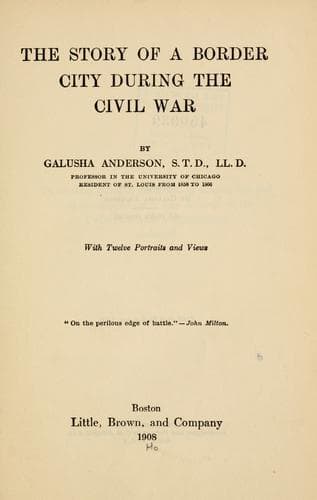
The story of a border city during the Civil WarAnderson, Galusha
History
The story of a border city during the Civil War
Anderson, Galusha
Missouri -- History -- Civil War, 1861-1865; Saint Louis (Mo.) -- History -- Civil War, 1861-1865
Many suggestive incidents pertaining to them, some sad, some
mirth-provoking, came under my eye. The contrabands usually trudged into
the city in groups, bearing in their hands or on their shoulders
budgets, filled with old clothing or useless traps, their heads covered
with dilapidated hats or caps, or, in the case of the women, wrapped
about with red bandanas. Their garments were coarse, often tattered, and
usually quite insufficient to shield them against the cold of winter.
They wore shoes and boots of cowhide which in very many cases were
nearly worn out, so that often their black toes protruded. But one cold,
frosty, winter day a motley company of fugitives, men, women and
children, came marching in barefooted. We asked them how they came to be
in such a wretched plight? They said that as they were going “long de
road” out in the country, some “Confed sogers” seized them, set them on
a bank by the roadside, and pulled off their shoes, and then told them
just to run for their lives. Their unusual predicament, and the
unanimity and heartiness of their artless testimony, convinced all who
heard that they told the truth. It might have been horse-play on the
part of some company of the State Guards, but if so, it was a grim and
terrible joke to this knot of contrabands, compelling them to walk many
miles with bare feet along frozen, snowy roads, the feet of the little
children frost-bitten and bleeding.
An occurrence vastly more pathetic was woven into my pastoral
experience. A slaveholder of the cruel sort lived near Jefferson City.
There belonged to him a little girl eight years old, together with her
mother and aunt. The early winter of 1861 and 1862 was bitterly cold.
During one of the severest days of that trying season, the thermometer
hovering about zero, he compelled these two women to saw wood all day
out in the open air, and the mite of a girl to bring the sawed sticks
into his wood-shed. With hands stinging from the biting frost, they
besought him to let them warm themselves by the fire; and he answered
their petition with the lash. Before the day ended they nearly perished
and the fingers of the child were frozen. That night they determined to
run away. They knew that on account of the war many other slaves were
quitting their masters; why should not they flee from the cruelty of
theirs? In the darkness the following night they slipt away unobserved.
They headed for St. Louis. The little child, always feeble, was soon
exhausted. So the mother and aunt by turns carried her on their backs.
They hid in ravines and thickets, when they thought themselves in
danger. They ate the crackers and bread that they brought with them.
They slept by haystacks and in outhouses. They were frost-bitten. They
were full of fear lest the child should die. For seventy-five or eighty
miles they breasted wind and snow, when they met a squad of Union
soldiers, and asked them for protection and guidance. The soldiers as
Public-domain text, read in full here on John Shaqi.
Reviews
Reviews
No reviews yet
Be the first to share your thoughts on this work.
Elsewhere in the archive
Join the Discussion
Join the discussion
Sign in to leave a comment or review.
Sign InorCreate an account