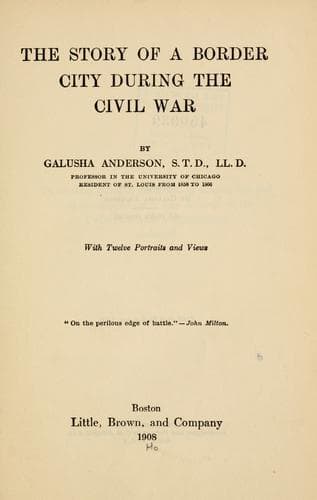
The story of a border city during the Civil WarAnderson, Galusha
History
The story of a border city during the Civil War
Anderson, Galusha
Missouri -- History -- Civil War, 1861-1865; Saint Louis (Mo.) -- History -- Civil War, 1861-1865
He said that he would like to learn to read, and for a good many weeks I
tried to instruct him in the art. But being utterly unaccustomed to that
sort of mental effort, he made very slow progress. However, by degrees,
he mastered the names of the letters, and was able with painful effort
to read a few of the simplest words. He was a Christian and wanted to
read the Bible. So I bought him a New Testament of large, plain print
and, after a hard struggle, he was seemingly able to read the text:
“Come unto me, all ye that labor and are heavy laden, and I will give
you rest.” He was very happy over his acquisition, and so was I. He
would read that text over and over again. He had no doubt that he really
read it, nor had I. But wishing him to add something to his
acquisitions, I turned to another chapter in the Gospel of Matthew, and,
putting my finger on a verse, asked him to read it. He intently fixed
his eyes upon it and began: “Come unto me, all ye that labor and are
heavy laden, and I will give you rest.” I asked him to read another
verse, in another chapter, and running his finger along the words, he
read: “Come unto me, etc.” I afterwards found him at times reading his
New Testament, but I feel quite sure that he never found anything in it
except that gracious, tender invitation of his Saviour. He of course
read simply from his memory, but thought that he read from his book.
I afterwards united him in marriage to an excellent colored woman. They
set up housekeeping for themselves. They did well and were happy.
Whether Jim lives now or not, I do not know, but if he has passed away,
I am sure that in the hour of his death he heard his Lord say: “Come
unto me, all ye that labor and are heavy laden, and I will give you
rest.”
The other contraband servant was a middle-aged woman, who gave her name
as Harriet. She was large and muscular, and black as ink. She would pick
up, as though it were a trifle, a washtub full of water and carry it
across the room. Nothing seemed to weary her, She did cheerfully her
daily tasks. She was happy in her new-found freedom. To receive week by
week money for her labor made her cup of joy brim over. The dawning
consciousness that she belonged to herself and had a right to what she
earned filled her with unspeakable gladness.
She too had an abiding trust in Christ. She said she was “_Methdis_.”
She had an active mind. She was intellectually much brighter than Jim.
Her new condition and surroundings awakened within her mind many
inquiries. Busy with her new thoughts as she worked, one day she said:
“Dar ah some tings that I doan unerstan. Up in de State where I lived,
wen thar was ’vival meetin an dey wanted us to be good and ’jine’ de
chuch, den we had souls; but wen dey wants to sell us down souf, den we
has no souls. Can you tell me about dat? Seems mighty strange!”
Public-domain text, read in full here on John Shaqi.
Reviews
Reviews
No reviews yet
Be the first to share your thoughts on this work.
Elsewhere in the archive
Join the Discussion
Join the discussion
Sign in to leave a comment or review.
Sign InorCreate an account