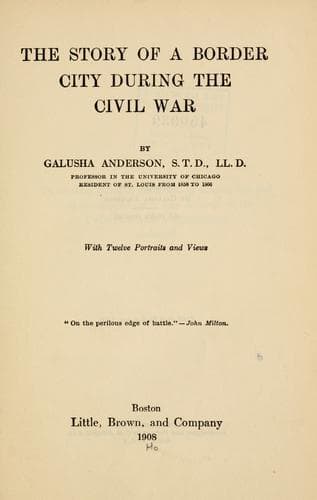
The story of a border city during the Civil WarAnderson, Galusha
History
The story of a border city during the Civil War
Anderson, Galusha
Missouri -- History -- Civil War, 1861-1865; Saint Louis (Mo.) -- History -- Civil War, 1861-1865
This was an outburst from an honest, sturdy soul, that had been kept in
ignorance. It vividly revealed the antagonistic forces that often
battled for supremacy in the minds of Christian slaveholders. When they
sorely needed money they stifled their consciences with the figment that
their slaves were merely beasts, that might be sold with impunity; but
when their better selves were touched by heavenly influences, they felt
that their chattels had immortal souls that might be saved or lost. It
has been said that some men, like modern ships, are made up of distinct
compartments, which, in moral action, have no communication with each
other. So it seems to have been with some professedly Christian
slaveholders; at slave sales and whipping-posts the tyrant compartment
was in full and exclusive activity; while at revival meetings the
Christian compartment put forth its exclusive energy.
CHAPTER XVIII
DIFFICULT CURRENCY
When the Federal government, soon after the breaking out of the war,
began to issue paper money, all specie, both gold and silver, speedily
disappeared. For many years the five-cent piece had been the smallest
coin used in the stores and markets of St. Louis. It was silver, since
the day of the nickel had not yet come. The copper cent, then large and
cumbersome, was absolutely tabooed in our city; it was nowhere current
except at the post-office. This was always a surprise to newcomers, and
sometimes an embarrassment. A lady, who was a comparative stranger to
our customs, going to the market when cabbages were unusually abundant,
asked a vender the price of them, and was quite upset when he replied,
“Six for five cents, madam.” “But,” she gasped, “I don’t want so many.”
“Very well,” he said, “take them as you want them.”
But when all coins had disappeared both buyers and sellers were often at
their wits’ end, and only by patience and mutual forbearance could
ordinary business be transacted.
Public-domain text, read in full here on John Shaqi.
Reviews
Reviews
No reviews yet
Be the first to share your thoughts on this work.
Elsewhere in the archive
Join the Discussion
Join the discussion
Sign in to leave a comment or review.
Sign InorCreate an account