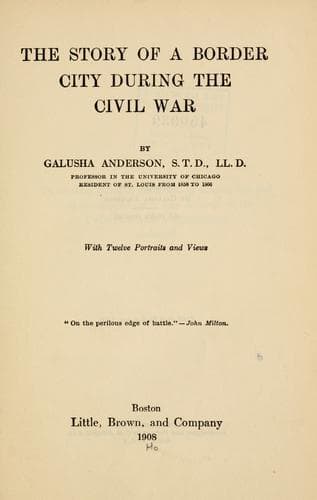
The story of a border city during the Civil WarAnderson, Galusha
History
The story of a border city during the Civil War
Anderson, Galusha
Missouri -- History -- Civil War, 1861-1865; Saint Louis (Mo.) -- History -- Civil War, 1861-1865
Their hostile campaign had been manifestly skilfully planned. Their open
and aggressive movement began in the latter part of June. All at once
guerrillas swarmed in every part of the State. It is estimated that
there were full ten thousand of them.[89] They were first in northeast,
then in central and western, Missouri; now here, now there, they looted
and burned the houses of Union men; plundered farms and villages; tore
up railroad tracks; destroyed bridges; attacked different detachments of
militia; were by turns victorious and defeated; but on August 13th,
having massed their forces, they won a signal victory over the Union
troops at Independence, and two days later ambushed eight hundred of
them in Jackson County. No one now cares for the rebel Colonels Porter,
Quantrell, Cobb, Poindexter, Coffee, McBride and Hughes; but they were
then the chief figures in these scenes of desolation. But when they were
at the height of their success, the scale turned. General Blunt from
Kansas appeared with a small but well-appointed army and drove them with
their ill-gotten plunder into Arkansas.
But as flies when brushed away at once return again, so they appeared
again in September, in northeast Missouri, and so effective were their
movements that for the time being they took possession of that part of
the State, except posts adequately garrisoned by United States troops.
But during this period of turmoil General Schofield was wide awake. On
June 22d, very soon after these devastating raids began, he issued an
order in which he held “rebels and rebel-sympathizers responsible in
their property, and, if need be, in their persons, for damages
thereafter committed by guerrillas or marauding parties.” And while this
had no immediate effect the order was not in vain. It was the precursor
of energetic action. On the 22d of July, Governor Gamble authorized the
general to organize the entire militia of the State, and to order so
much of it into active service, as he should deem necessary to put down
all marauders, and to defend the peaceable citizens of the commonwealth.
On the same day, Schofield commanded the immediate organization of the
militia “for the purpose of exterminating the guerrillas infesting the
State.” This difficult work was pushed with great rapidity and was soon
effected.
Public-domain text, read in full here on John Shaqi.
Reviews
Reviews
No reviews yet
Be the first to share your thoughts on this work.
Elsewhere in the archive
Join the Discussion
Join the discussion
Sign in to leave a comment or review.
Sign InorCreate an account