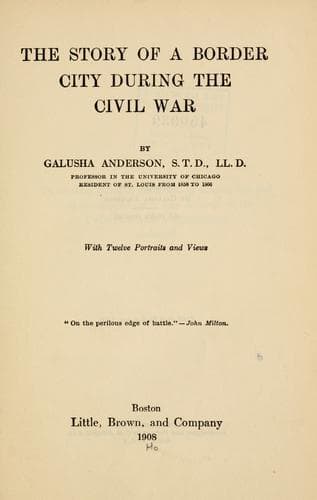
The story of a border city during the Civil WarAnderson, Galusha
History
The story of a border city during the Civil War
Anderson, Galusha
Missouri -- History -- Civil War, 1861-1865; Saint Louis (Mo.) -- History -- Civil War, 1861-1865
CHAPTER XIX
NOT PEACE BUT THE SWORD
On the 19th of May, 1862, Edward Everett came to us and delivered his
famous oration on Washington. Very few in our city had ever before seen
him. A large audience of the most intelligent and cultured among us
gathered to hear him. The style of his great speech was clear and
finished; his elocution, while a little stately, was nearly faultless;
his voice was agreeable and reaching; his gestures graceful and fitting,
but he lacked magnetism. His whole effort seemed somewhat studied and a
bit mechanical. When pronouncing a given phrase he stretched out his arm
and from the palm of his hand extended one finger; when uttering
another, he extended two fingers; when enunciating another, three
fingers; and now and then in making a full-arm gesture he opened the
whole hand. One could not help thinking that before appearing in public
he had carefully drilled himself before a looking-glass.
His audience listened intently, but was not much moved. He appealed to
the head far more strongly than to the heart. Still to sit at the feet
of so distinguished an orator was to us all a rare treat.
He was not only gathering funds to complete the Washington monument at
the national capital, but was still endeavoring, through the love borne
to Washington by the people both of the North and South, to unite a
divided and warring nation. Amid the clash of arms he was eloquently
pleading for peace. His purpose was noble, but his effort was futile.
The ears of contending hosts, seething with the passions of war, were
deaf to all appeals for peace. One might as well have undertaken to put
out the fires of a conflagration by a speech, as to stay the bloody
national conflict then raging by an oration on Washington.
Fiercer war soon followed this eloquent pleading for good will and
harmony. When, in April, General Halleck departed for Corinth,
Mississippi, he left General Schofield in command of the greater part of
our State, and on the 1st of June he put him in temporary command of the
entire Department of Missouri. General Schofield now sent all the
soldiers that could possibly be spared from St. Louis and Missouri to
swell the ranks of the army in Mississippi. The ever watchful enemy
learned from spies among us that we were largely denuded of national
troops, and determined to put forth one more vigorous effort to secure
the secession of Missouri.
Public-domain text, read in full here on John Shaqi.
Reviews
Reviews
No reviews yet
Be the first to share your thoughts on this work.
Elsewhere in the archive
Join the Discussion
Join the discussion
Sign in to leave a comment or review.
Sign InorCreate an account