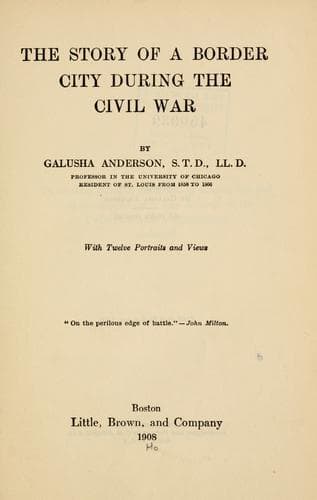
The story of a border city during the Civil WarAnderson, Galusha
History
The story of a border city during the Civil War
Anderson, Galusha
Missouri -- History -- Civil War, 1861-1865; Saint Louis (Mo.) -- History -- Civil War, 1861-1865
When, in 1861, the war broke out in Missouri, and the battles of
Boonville, Carthage, Dug Spring and Wilson’s Creek were fought, and
collisions and skirmishes multiplied throughout the State, the demand
for greater hospital accommodations at St. Louis became imperative. The
New House of Refuge Hospital, two miles south of the city, proved to be
altogether inadequate; and when all the wards of the St. Louis Hospital,
kept by the Sisters of Charity, and of the City Hospital had been
filled, still more room was at once required.
To meet this urgent necessity something must be done immediately. In our
straits we appealed to General Fremont, who promptly came to our
aid,[93] and, on September 5th, issued an order, authorizing the Western
Sanitary Commission, under the medical director of the army, to select,
fit up, and furnish suitable buildings for “Army and Brigade Hospitals;”
to choose and appoint, under the authority of Miss Dorothea L. Dix,
general superintendent of the nurses of military hospitals in the United
States, female nurses; to cooperate with the surgeons of the army in
providing male nurses; to visit the various military camps, consult with
the commanding officers in reference to the sanitary condition of the
troops, and aid them in providing the best means for preventing
sickness, such as proper drainage, warm clothing and wholesome food.
Moreover the Commission was enjoined to use every available means for
the promotion of the social and moral welfare of the soldiers. To
satisfy the varied wants of those in camps and hospitals, the Commission
was directed to procure from the people at large such supplies as they
would freely contribute to supplement those furnished by the government.
But all this must be done in full and hearty cooperation with the
regular medical staff of the army, some members of which were jealous of
their honors and at times foolishly sensitive to innovations.
Finally, the general’s order declared that “This Sanitary Commission
will, for the present, consist of James E. Yeatman, Esq.; C. S. Greely,
Esq.; J. B. Johnson, M. D.; George Partridge, Esq.; and Rev. William G.
Eliot, D. D.” Two of these were broadminded, enterprising merchants; one
was a physician of high standing; while Mr. Yeatman was a retired
Tennessee planter. He had been a slaveholder; but, called to go down the
Mississippi River on business, he received from what he saw during his
trip such an impression of the enormity of slavery, that, when he
returned, he manumitted his slaves, sold his plantation, and thereafter
made St. Louis his home. He was a rare man. He was eminently just. He
saw clearly the fundamental elements of every problem presented to the
Commission for solution. He had large administrative ability, a sharp
eye for details, and, to crown all, a great heart. Few men in the nation
did more than he to bring the war to a successful issue.
Public-domain text, read in full here on John Shaqi.
Reviews
Reviews
No reviews yet
Be the first to share your thoughts on this work.
Elsewhere in the archive
Join the Discussion
Join the discussion
Sign in to leave a comment or review.
Sign InorCreate an account