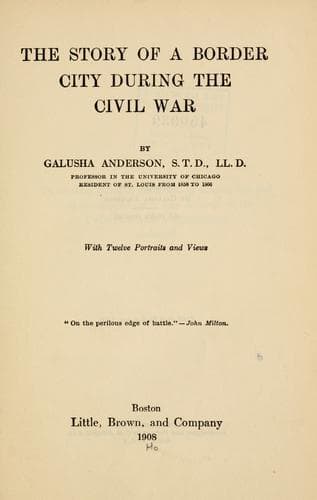
The story of a border city during the Civil WarAnderson, Galusha
History
The story of a border city during the Civil War
Anderson, Galusha
Missouri -- History -- Civil War, 1861-1865; Saint Louis (Mo.) -- History -- Civil War, 1861-1865
Dr. Eliot, whose name stands last on this roll of honor, was the pastor
of the only Unitarian church in our city. By long and efficient
ministerial service he had endeared himself to all the people. His name
in St. Louis was a household word. But he was as noted for his skill and
efficiency in inaugurating and successfully conducting large public
enterprises, as for his wise and multifarious pastoral labors. He was
the founder of Washington University and of Mary Institute, and it was
through his personal efforts that these institutions, an ornament to our
city, were built up. In fact every beneficent enterprise in St. Louis
felt the stimulating touch of his hand and was indebted to him for his
thoughtful guidance. Among the ablest pastors of our city, he was
unquestionably best equipped for membership in this all-important
Sanitary Commission.
The Commission, thus organized and launched, at once began its labors.
It rented a five-story building at the corner of Fifth and Chestnut
Streets, and speedily fitted it up for hospital service. It was named
the “City General Hospital.” On September 10th, it was thrown open for
the reception of patients. A throng of sick and wounded men, who had
been anxiously waiting for accommodation and succor, quickly filled all
its rooms.
In this building the Sanitary Commission made its headquarters. Mr.
Yeatman was chosen president and gave his whole time to his duties,
while the other members of the Commission met with him every day, except
Sunday, for consultation. For this incessant, exacting toil no one of
them received any moneyed compensation. Without a thought of personal
gain they worked unremittingly and cheerfully for their country. The
only motive that impelled them was a glowing, self-sacrificing
patriotism. For a time, they employed only one man, and he acted as
storekeeper, porter and clerk for thirty dollars a month. And this
gratuitous, arduous service, beset at times with swarms of perplexities,
was continued to the close of the war.
The sick and wounded of the army multiplied so rapidly, and the demand
for medical aid became so insistent, that within two months after the
opening of the first hospital, the Commission, with almost incredible
energy, had added five more and all were filled to overflowing.
Public-domain text, read in full here on John Shaqi.
Reviews
Reviews
No reviews yet
Be the first to share your thoughts on this work.
Elsewhere in the archive
Join the Discussion
Join the discussion
Sign in to leave a comment or review.
Sign InorCreate an account