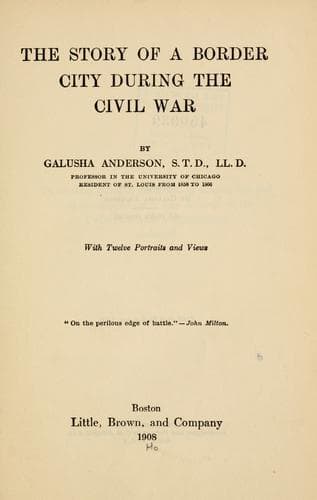
The story of a border city during the Civil WarAnderson, Galusha
History
The story of a border city during the Civil War
Anderson, Galusha
Missouri -- History -- Civil War, 1861-1865; Saint Louis (Mo.) -- History -- Civil War, 1861-1865
Mr. Yeatman himself often went down the river to superintend in person
this ever-expanding work of benevolence. On one of his expeditions, he
took to Grant’s army, then engaged in the siege of Vicksburg, two
hundred and fifty tons of sanitary supplies. And during all that
protracted siege, the floating hospitals fitted out by the Commission
were just at hand.
But the Commission did not confine itself wholly to the West. During the
Peninsular Campaign by McClellan, they sent sanitary stores to
Washington; and from May 1st to November 1st, 1864, forwarded to
Sherman’s army, operating in Georgia, supplies “amounting to hundreds of
tons.” Nor did they forget the starving prisoners at Andersonville, but
sent them through General Sherman such stores as were imperatively
needed to alleviate their appalling miseries, although these gifts of
mercy never reached their destination. When, however, at a later day, a
goodly number of these prisoners were exchanged at Vicksburg, the same
supplies were then distributed among them, and when they saw on the
boxes the name of General Sherman, their joy was unbounded.
But in this meagre sketch of the magnificent work of the Sanitary
Commission, we wish in a few lines to give at least a hint of its
efforts to meet in some measure the necessities of the freedmen outside
of St. Louis. Between Cairo, Ill., and Natchez, Miss., at least forty
thousand of them were found that greatly needed help. That whole region
had been for months a battle-ground. Landowners had fled. Plantations
were broken up. Slaves, happy in their new-found freedom, had followed
our armies, looking upon them as their deliverers; yet bewildered as to
what they were to do. Some Union generals, impeded by them, and lacking
in humanity, treated them with cruelty. Especially was this true at
Helena and Memphis, where they compelled the freedmen to work hard
without compensation, while their families were left in extreme want.
This to Mr. Yeatman was like a trumpet blast. He took hold of this new
problem with marvellous energy. He appealed to the country for help.
There was benevolent response from almost every quarter. Massachusetts
especially sent in generous quantities both goods and money. Nor did St.
Louis lag behind in her gifts. The replenished Commission sent to the
hungry and ragged freedmen large supplies of both food and clothing;
established hospitals for them in different places; provided them with
physicians, nurses and medicines; put a stop to the tyranny of
inconsiderate or hard-hearted military officers; and established schools
for them in which they were taught to read, and write, to add and
substract, and to do properly the ordinary work of the kitchen and
field. Mr. Yeatman went over all the territory where the men and women,
sent out by the Commission, were working for the freedmen, and gave to
them such suggestions and directions as in his judgment would render
their work most beneficent and fruitful.
Public-domain text, read in full here on John Shaqi.
Reviews
Reviews
No reviews yet
Be the first to share your thoughts on this work.
Elsewhere in the archive
Join the Discussion
Join the discussion
Sign in to leave a comment or review.
Sign InorCreate an account