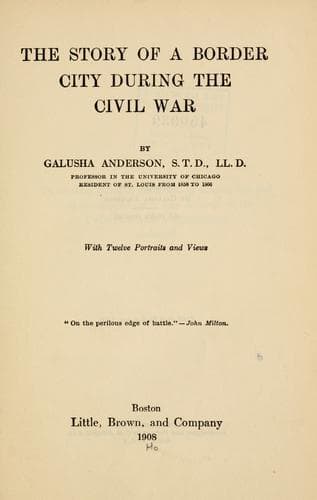
The story of a border city during the Civil WarAnderson, Galusha
History
The story of a border city during the Civil War
Anderson, Galusha
Missouri -- History -- Civil War, 1861-1865; Saint Louis (Mo.) -- History -- Civil War, 1861-1865
He himself established for the
freedmen a system of work on plantations around Vicksburg, which, before
the close of the war, yielded the best results. On behalf of his project
he appealed to the public through the press; laid it personally before
the President and found for it an open ear and thus enlisted the
government on its behalf. He had the qualities needed for dealing with
an ignorant people just freed from bondage: sense, justice, and love.
Still our cursory survey of the work of the Commission would be quite
incomplete without casting a glance at what they did for the white
refugees in all that great region south of Missouri on both sides of the
Mississippi River. Great as the number of these refugees was in St.
Louis, it was far greater in that vast territory. There the Commission,
as exigencies arose, selected, one after another, ten central points,
each of which was made headquarters for all the region contiguous to it.
At these centres they founded temporary hospitals, and opened schools
for the refugees. They fed, clothed, taught and nursed them, and, so far
as practicable, put them to work. It takes but a moment to write this,
but these words are a symbol representing a prodigious amount of
patient, self-sacrificing toil.
Moreover, the Soldiers’ Home had proved itself to be so great a blessing
in St. Louis, that the Commission established five others in the States
to the south conquered by our armies. And up to December, 1865, all
these Homes, including the one in our city, had entertained without
charge four hundred and twenty-one thousand six hundred and sixteen
soldiers; furnished them nine hundred and eighty-two thousand five
hundred and ninety-two meals, and four hundred and ten thousand two
hundred and fifty-two lodgings.
In all this beneficent work the loyal inhabitants of St. Louis had a
large share. We liberally contributed to it goods, money and service.
But the demands upon us within our own gates were onerous and well nigh
exhausting. The time, strength and material resources of every one were
laid under tribute; tribute which, for the most part, was gladly paid.
All Christian pastors and priests worked much in camps and hospitals.
They conducted many public services, often preached, and incessantly
ministered to the sick and dying.
When volunteers began to gather in large numbers at St. Louis, in
connection with other pastors of the city, I preached, as I had time and
opportunity, in the camps. I was greeted by attentive, intelligent
audiences. Many regiments were made up largely of Christian men who,
while encamped, regularly maintained prayer meetings. There was one
regiment from Illinois, having in its ranks above a thousand young men,
more than half of whom read their Greek Testaments.
But we met them for religious services not only in camp, but also in
buildings in the city specially provided for that purpose.
Public-domain text, read in full here on John Shaqi.
Reviews
Reviews
No reviews yet
Be the first to share your thoughts on this work.
Elsewhere in the archive
Join the Discussion
Join the discussion
Sign in to leave a comment or review.
Sign InorCreate an account