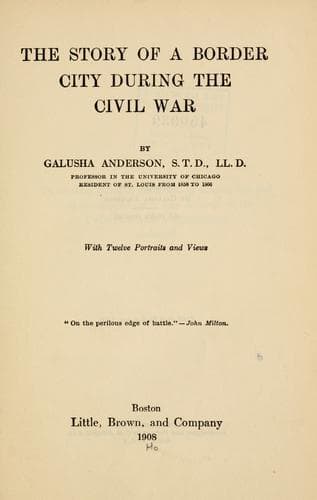
The story of a border city during the Civil WarAnderson, Galusha
History
The story of a border city during the Civil War
Anderson, Galusha
Missouri -- History -- Civil War, 1861-1865; Saint Louis (Mo.) -- History -- Civil War, 1861-1865
There were in this hospital, as in all the rest, some professional women
nurses, and they were very efficient. They did their work not only with
technical skill, but they had that prime quality that must ever
characterize nurses of the highest order, heartfelt sympathy with those
whose sufferings they strove to alleviate. But in addition to these,
there were many volunteer nurses, women, who, by regular appointment,
were there at all hours of the day and night. They were ready to do any
service within their power. They worked under the direction of the
physicians and in harmony with the professional nurses. They often
brought with them, from their own household stores, such appetizing
foods as reminded the sick soldiers of the tender nursing that in homes
far away they had sometimes received from mother or sister. A little
gruel or soup, or fruit, or jelly, how grateful to the palate, and
cheering to the spirit! The very thought of it started many a sick
soldier boy on the road to health and further service in the field.
The tender sympathy which these women lavished on the suffering was
often more healing than medicine. And when, sitting by the bedside of
languishing heroes, sick it may be even unto death, they wrote letters
for them to the loved ones at home, these missives throbbed with a
mother’s love and were often wet with a mother’s tears.
An incident of that kind comes vividly to mind as I write. A young man
from Indiana lay on his death-bed. He was about twenty-two years old and
fully six feet in height. He was muscular and strong. But pneumonia had
seized upon him and had baffled the best skill of the surgeon. He had
been told that he could not live more than five or six hours longer. But
he was a Christian and had hope of a glorious immortality. In the final
arrangement of his affairs he was as calm in spirit as if he were going
out on dress parade. By his cot sat a young mother. He asked her to
write to his family and tell them what to do with his things. She wrote
as he suggested, her heart almost bursting with emotion. He gave one
thing to this sister, another to that brother, and last of all he said,
“I give Jeff. C. Davis to my youngest brother.” “But what is Jeff. C.
Davis?” asked the one who was writing for him his last letter, and there
were tears in her voice. He replied, a smile playing around his lips,
“It is my colt. I named him for General Davis, who is an Indianian and
very popular in our State.”
Public-domain text, read in full here on John Shaqi.
Reviews
Reviews
No reviews yet
Be the first to share your thoughts on this work.
Elsewhere in the archive
Join the Discussion
Join the discussion
Sign in to leave a comment or review.
Sign InorCreate an account