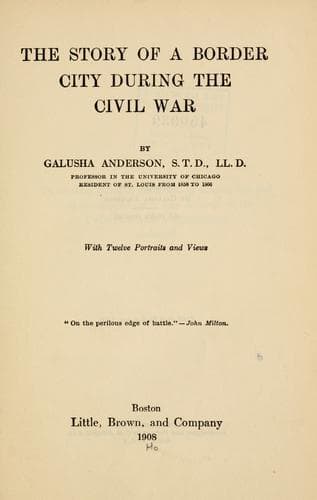
The story of a border city during the Civil WarAnderson, Galusha
History
The story of a border city during the Civil War
Anderson, Galusha
Missouri -- History -- Civil War, 1861-1865; Saint Louis (Mo.) -- History -- Civil War, 1861-1865
It was no formal letter which she penned in that sad hour. Into its
words and sentences went the glowing sympathy of a mother’s heart. But
it is only an example of thousands of others. When the letter was
finished, the face of the young man betokened the most perfect
satisfaction. His work was done. He was ready to depart. I prayed with
him. I left him with a smile on his face. He was so cheerful that I
began to think that the surgeon had made a mistake; but when I returned
a few hours afterwards, “he was not, for God took him.”
In addition to the above it is with no little pleasure that I give one
incident among many that vividly reveal the patriotic devotion of the
rank and file of our army. Near the beginning of the war, I was called
one night to marry a volunteer cavalry soldier. Immediately after, he
rode away under the command of Zagonyi, to Springfield, Missouri. In
entering that city a charge was made between two lines of Confederate
soldiers, and my friend was shot. For several hours he lay on the frosty
ground, slowly bleeding; and then, faint and exhausted, he was put into
an army wagon which went jolting over rough roads to Rolla, and from
there he was sent by the cars to St. Louis. I found him in the hospital,
so changed that I did not at once recognize him. But when all doubt as
to his identity was brushed away, he pathetically told me the story of
his suffering. He had been shot through the shoulder; the bone had been
shattered; pieces of it had protruded from the wound and had been
removed. He had preserved them. They were more precious to him than
diamonds. He kept them neatly wrapped in a paper under his pillow. With
his trembling, emaciated hand he took them out slowly and carefully
unwrapped them and showed them to me. Then wrapping them up again, he
put them back under his pillow, and looking up, his eye began to gleam
as he said: “The doctors say that I cannot recover. I think that they
are mistaken. I shall get well. You see that it is the left shoulder
that is wounded. When it heals it will be stiff, but I can still hold
the reins of my horse in my left hand; and then, sir,” with great
emphasis for an apparently dying man, he added, “I have one more
shoulder for my country.” He did live to fight many a hard battle
thereafter. But I could never forget those brave, burning words, words
instinct with self-sacrifice: “Then, sir, I have one more shoulder for
my country.”
Public-domain text, read in full here on John Shaqi.
Reviews
Reviews
No reviews yet
Be the first to share your thoughts on this work.
Elsewhere in the archive
Join the Discussion
Join the discussion
Sign in to leave a comment or review.
Sign InorCreate an account