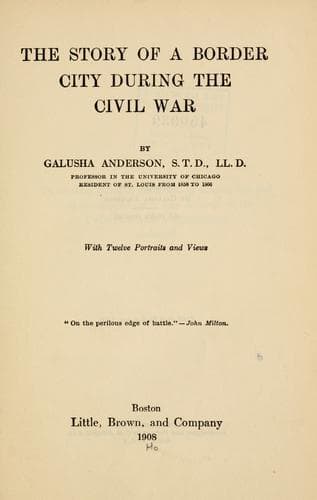
The story of a border city during the Civil WarAnderson, Galusha
History
The story of a border city during the Civil War
Anderson, Galusha
Missouri -- History -- Civil War, 1861-1865; Saint Louis (Mo.) -- History -- Civil War, 1861-1865
One feature was specially novel. The colored soldiers, enlisted and
drilled under the direction of General Schofield, during the Fair
constantly did guard duty. They also distinguished themselves, and
greatly commended themselves to all right-minded people, by liberally
contributing from their meagre wages to aid the refugees and freedmen.
Colored people also freely visited the Fair and made purchases. It
looked like a revolution when we saw, in a slave State, white women of
high social standing, without complaint or a murmur, sell articles to
colored purchasers. Once or twice indeed some whites took offence at
this radical and apparently abrupt change from the old order of things,
but on the whole the sentiment toward the colored people was humane,
reasonable, and liberal.
The Fair proved a great financial success. Its net proceeds were five
hundred and fifty-four thousand five hundred and ninety-one dollars, at
least three dollars and fifty cents for each inhabitant of our city; but
the result was largely due to contributors beyond our borders;
nevertheless it can be said of St. Louis that she did the work which
made this great success possible, and at the same time liberally gave to
the Fair both merchandise and money. The large amount of money realized,
together with other donations, enabled the Sanitary Commission to
complete its great work. In addition to the sums of money that it
directly disbursed to aid our armies, it appropriated to the Ladies’
Union Aid Society fifty thousand dollars for hospital work and the
assistance of soldiers’ families. It also devoted one thousand dollars
per month to the aid of the freedmen, and established at Webster, ten
miles west of the city, a Soldiers’ Orphans’ Home, at a cost from first
to last of over forty thousand dollars. The Home accommodated one
hundred and fifty fatherless children.
But the Fair was a blessing not only to refugees and freedmen, to the
sick and wounded in hospitals, to the widows and orphans of our slain
heroes, but it was also a measureless boon to St. Louis. It was one more
mighty agency for curing us of our selfishness. For a time at least it
broke in upon our commercialism, and led us to think of others and to do
something for their welfare.
CHAPTER XXIII
A DARK PLOT THWARTED
When Major-General Rosecrans, on January 30th, 1864, assumed command of
the Department of Missouri, he delivered to his predecessor, General
Schofield, a complimentary farewell address. He warmly commended him for
what he had done in our State, and congratulated him that he was about
to take part in great campaigns. It was no flattery, but a candid,
sincere utterance of which the recipient was altogether worthy. It was
an honor both to him who uttered it and to him on whom it was bestowed.
Public-domain text, read in full here on John Shaqi.
Reviews
Reviews
No reviews yet
Be the first to share your thoughts on this work.
Elsewhere in the archive
Join the Discussion
Join the discussion
Sign in to leave a comment or review.
Sign InorCreate an account