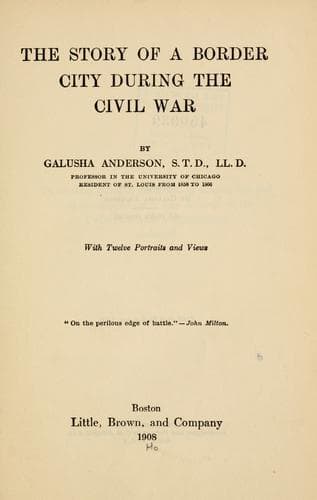
The story of a border city during the Civil WarAnderson, Galusha
History
The story of a border city during the Civil War
Anderson, Galusha
Missouri -- History -- Civil War, 1861-1865; Saint Louis (Mo.) -- History -- Civil War, 1861-1865
During the days of preparation for the Fair a committee was appointed to
meet a delegation from our German fellow-citizens and if possible
persuade them to give up the project of selling beer at the Fair. I was
chairman, and presented as well as I could the earnest desire of the
temperance people. The German, who was the spokesman of his delegation,
understood English quite perfectly, but could not speak it very well. He
had not been at all persuaded by the considerations that I had
presented, and among other things that he vehemently urged in reply was
this: “Zhentelmen,” said he, “lager peer vill not make men trunk; it
vill not, _it vill not_. Zhentelmen, and ef any one gets trunk, we have
already, zhentelmen, engaged the police to take him to de calaboose.” So
this, and every effort that we put forth to rid the Fair of lager beer,
proved abortive; and it was sold, innumerable kegs of it, to alleviate
the sufferings of our soldiers. But in justice it ought to be added that
no one became so intoxicated that it was necessary to take him to the
calaboose.
But we can only name the multiplied departments and varied attractions
of this famous Fair. It had its curiosity shop, and skating park; its
floral park and gallery of fine arts; its counters on which all kinds of
merchandise were offered for sale; its separate rooms for war trophies,
agricultural implements, sewing machines, for the sale of works of art,
and for the exhibition of gold and silver bars from Nevada. There were
also refreshment saloons or restaurants, the New England, and the
Holland kitchen, where patriotic women cooked and washed dishes for the
Union and where the hungry ate for the same lofty purpose. And then
there were confectioners’ counters, a café, and an improvised theatre,
where were presented various dramas and other public amusements.
Patriotism, the underlying motive of it, lifted up and glorified all the
drudgery and all the innocent pastimes connected with it.
The evenings at the Fair were made specially attractive. Then the men
that had been absorbed in business during the day came with their
families. The great building was lighted as brilliantly as it could be
with gas. Electric lights had not yet appeared. In the gallery trained
bands skilfully discoursed patriotic music. Often the commanding general
with his staff, in their brightest uniform, was present. It is wonderful
how the crowd is charmed by military clothes! The names of the Union
generals together with the names of the battles that they had fought
were blazoned on the walls, and the Stars and Stripes hung out
everywhere, while women from the first families of the city were busy
selling all sorts of useful articles. No one who shared in those
festivities, who saw and heard and drank in the spirit of that patriotic
throng can ever forget it.
Public-domain text, read in full here on John Shaqi.
Reviews
Reviews
No reviews yet
Be the first to share your thoughts on this work.
Elsewhere in the archive
Join the Discussion
Join the discussion
Sign in to leave a comment or review.
Sign InorCreate an account