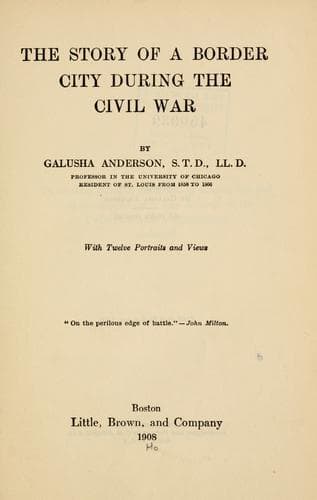
The story of a border city during the Civil WarAnderson, Galusha
History
The story of a border city during the Civil War
Anderson, Galusha
Missouri -- History -- Civil War, 1861-1865; Saint Louis (Mo.) -- History -- Civil War, 1861-1865
But, just as we expected, they affirmed that they could do nothing for
the colored children under the existing law; but unsolicited they
pledged themselves to petition the next legislature for a law that would
enable them to provide school buildings, books, apparatus, and teachers
for the black children, and to support these schools, just as the
schools for white children are maintained, by the public school funds.
They were as good as their word. The legislature to which they appealed
was mainly made up of men of radical, progressive views, and what was
asked was enthusiastically granted. The school buildings for colored
children were put up and all that could make these schools most highly
efficient was liberally provided. The negro question for Missouri was
solved in this high-minded, philanthropic way, and the solution was
unstained by partisanship or demagogism; and in it we saw the grand
fruition of our toil on behalf of a few private negro schools.
CHAPTER XXV
AFTER DARKNESS LIGHT
In the beginning of the autumn of 1864 the Unionists of St. Louis were
sadly disheartened. They had not been so hopeless since the war began.
Men were unable to give any rational explanation of their
discouragement. It probably arose from a combination of untoward events.
Grant and Sherman had begun their great campaigns in Virginia and
Georgia. Some hard battles had been fought but no very decisive
victories had yet been gained. Mr. Lincoln had been renominated for the
Presidency, but without the triumph of our arms his election seemed to
us somewhat doubtful. For the opposing candidate the Democrats had
nominated General McClellan, who had many enthusiastic followers. In
their platform they had declared the war a failure. The existence of
“The Knights of the Golden Circle,” their great numbers in several
States of the Middle West and their ardent support of the Democratic
candidate had become quite generally known. Such an array of
antagonistic forces seemed to many of the loyal in our city, wearied
with the long and costly conflict for the Union, to betoken possible
defeat.
In this too general gloom I could not share. With other optimistic souls
I felt sure of ultimate victory. It was my duty, therefore, to impart so
far as possible my confidence to others; so I preached to a full house
from the text: “Think not that I came to send peace on the earth; I came
not to send peace, but a sword.” The press asked for my sermon and gave
it to a far greater number than those who heard it. Its closing passage
enshrines the spirit and stress of that day.
Public-domain text, read in full here on John Shaqi.
Reviews
Reviews
No reviews yet
Be the first to share your thoughts on this work.
Elsewhere in the archive
Join the Discussion
Join the discussion
Sign in to leave a comment or review.
Sign InorCreate an account