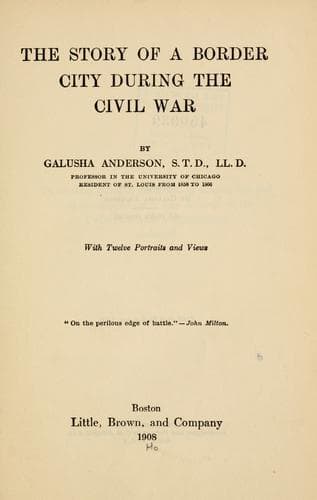
The story of a border city during the Civil WarAnderson, Galusha
History
The story of a border city during the Civil War
Anderson, Galusha
Missouri -- History -- Civil War, 1861-1865; Saint Louis (Mo.) -- History -- Civil War, 1861-1865
I was chosen to examine the colored applicants for positions as
teachers. In the months of September and October, I spent six half days
in the work of examination. It was a difficult task. These aspirants for
the responsible office of teacher knew accurately very little. The
superintendent of our city schools furnished me with the questions to be
asked. But these questions were framed for white teachers of larger
knowledge and greater discipline and were quite unfit for my purpose;
however, being required to use them, I did my best in Saul’s armor.
During the war the price of gold in New York was quoted in every daily
paper. It was one dollar and forty cents or one dollar and seventy-five
cents or two dollars and twenty-five cents, that is, it took so much in
paper currency to buy one dollar in gold. One of the questions
designated for these examinations was: “What is the leading industry of
New York?” referring of course to the State of New York. It was a rather
difficult question for any one to answer. I gave it to a bright-looking
colored girl, as a part of her examination. Her answer was, “Buying and
selling gold.”
Out of the fourteen that I examined, male and female, I found four that
showed that they were tolerably well-prepared for their duties as
primary teachers and they acquitted themselves very well in the
schoolroom.
Our schools flourished. Most of the pupils learned rapidly. The number
of them multiplied. Soon our room was insufficient. From time to time we
added other schools, and succeeded with small means in doing a great,
beneficent work.
We finally carried our case to the School Board of the city. We went
with faint hearts. In a community accustomed to slave laws, which public
opinion had heartily sustained, we were to ask the great boon of public
schools for those who by legislative enactment had been long kept in
ignorance. Moreover, the character of the men before whom we were to
plead the cause of the negro made us hesitate. Most of them were what
were then called Bourbon Democrats, who, it was declared, never learned
anything nor forgot anything, and a majority of the Board were Roman
Catholics. What could we expect men of that kind to do for the servile
and despised race among us? We were ushered into their presence. With
warm hearts we began to state our case. We criminated nobody. We spoke
earnestly and tenderly for the wronged and neglected. We were
wonderfully cheered when we saw that those whom we addressed were all
eye and all ear. They intently looked us in the face, they seemed
unwilling to lose a single word that fell from our lips. The injustice
that we pointed out was so rank that all their hearts were touched.
Without a dissenting voice they declared that the great wrong must be
righted; that the children of the men who paid a school tax must share
in its benefits.
Public-domain text, read in full here on John Shaqi.
Reviews
Reviews
No reviews yet
Be the first to share your thoughts on this work.
Elsewhere in the archive
Join the Discussion
Join the discussion
Sign in to leave a comment or review.
Sign InorCreate an account