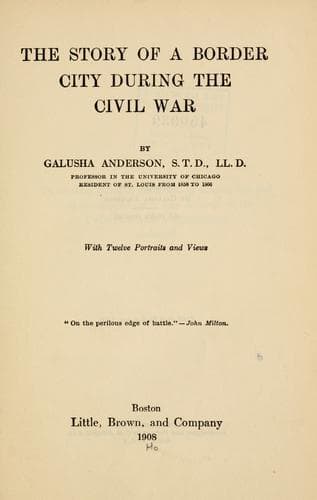
The story of a border city during the Civil WarAnderson, Galusha
History
The story of a border city during the Civil War
Anderson, Galusha
Missouri -- History -- Civil War, 1861-1865; Saint Louis (Mo.) -- History -- Civil War, 1861-1865
As we approached November the tide of public opinion turned in favor of
the election of Mr. Lincoln for a second term. The invasion of Missouri
had failed of its object. St. Louis was no longer threatened by her
foes; she was now secure and serene. The great secret political
organization, which aspired to destroy the Union and defeat the second
election of the President, had become innocuous; the fangs of the
copperhead had been drawn; Grant with the hammer of Thor, over
grass-covered fortifications, was steadily pounding his way towards
Richmond. Sherman had achieved brilliant success in Georgia. All things
for the cause of the Union were propitious. Lincoln’s election was
triumphant. Great patient soul, he now knew that he was enthroned in the
hearts of the people to whom he was so ardently devoted.
In Missouri many were kept from voting because they could not take the
prescribed oath of allegiance. On that account the result of the
election was not the real expression of the judgment of the whole
people; but it gave the most intense satisfaction to all radical Union
men of our city and State. The President received over forty thousand
majority; the unconditional Union candidate for Governor, Thomas C.
Fletcher, received a still heavier vote. The people, by more than
thirty-seven thousand majority, declared themselves in favor of another
Convention and at the same time elected the members of it, more than
three fourths of whom were Charcoals. The entire radical ticket for
State officers was chosen, and the legislature was heavily radical in
both its branches. Eight of the nine candidates elected to Congress were
radicals. In eighty of the one hundred and fourteen counties of the
State the radical ticket prevailed. The loyal of our city celebrated
this triumph of unconditional Unionism with unbounded joy. They rang the
bells; kindled bonfires; marched with torches to martial music; sang
patriotic songs; and almost split their throats and the welkin with
their huzzas. Well they might do all this. Every plot against the Union
had been thwarted; they held at last firmly within their grasp the prize
for which they had so long and patiently struggled. The darkness had
fled; the light shone.
CHAPTER XXVI
RADICALS IN CONVENTION[113]
Public-domain text, read in full here on John Shaqi.
Reviews
Reviews
No reviews yet
Be the first to share your thoughts on this work.
Elsewhere in the archive
Join the Discussion
Join the discussion
Sign in to leave a comment or review.
Sign InorCreate an account