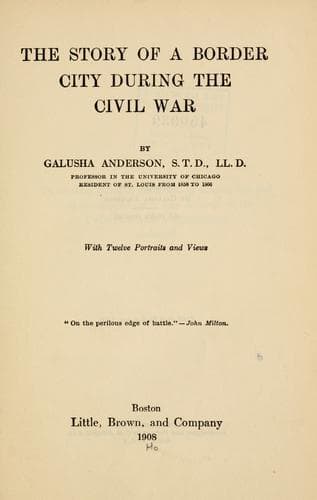
The story of a border city during the Civil WarAnderson, Galusha
History
The story of a border city during the Civil War
Anderson, Galusha
Missouri -- History -- Civil War, 1861-1865; Saint Louis (Mo.) -- History -- Civil War, 1861-1865
The radicals for many months had been deeply dissatisfied with the
conservatism of the old Convention. While recognizing its inestimable
service in keeping Missouri in the Union, they were strongly opposed to
its policy of gradual, compensated emancipation. They clamored for a new
Convention to which this, and other vitally important questions, should
be submitted. So many in the State adopted and advocated their views
that the legislature in February, 1864, passed an act creating and
calling a new Convention to meet in St. Louis on January 6th, 1865, “to
consider, first, such amendments to the Constitution of the State as may
be by them deemed necessary for the emancipation of slaves; second, such
amendments to the Constitution of the State as may be by them deemed
necessary to preserve in purity the elective franchise to loyal
citizens; and such other amendments as may be by them deemed essential
to the promotion of the public good.”
At the election in November, the people, as we have already noted, by a
decisive majority, declared for a new Convention and elected delegates
to it most of whom were radicals. The Charcoals were at last in the
saddle. The conservatives were dispirited; and even the more moderate
radicals held their breath in fear of measures too extreme and
impracticable. But, whatever drawbacks there were, on the whole the
radical triumph was a healthful onward movement.
On January 6th, 1865, the Convention met in the small Mercantile Library
Hall. There were sixty-nine delegates. More than half of them had been
born and bred in slave States. Twenty-three were natives of the free
States, while ten were immigrants from Europe, chiefly from Germany.
Some of those who were natives of the South had recently been converted
from their pro-slavery notions and were intent on magnifying their new
faith. They were uncompromising radicals.
Unlike the old Convention, there were in this more farmers than lawyers,
while the medical profession was as numerously represented as the legal;
almost one-fifth of the Convention were physicians. There were also
twelve merchants, mostly from small towns whose business had never been
large. Editors, clerks, a mechanic, a railroad agent, a law student, a
nurseryman, a surveyor, a schoolmaster, and a major of Missouri
volunteers made up the rest.
Public-domain text, read in full here on John Shaqi.
Reviews
Reviews
No reviews yet
Be the first to share your thoughts on this work.
Elsewhere in the archive
Join the Discussion
Join the discussion
Sign in to leave a comment or review.
Sign InorCreate an account