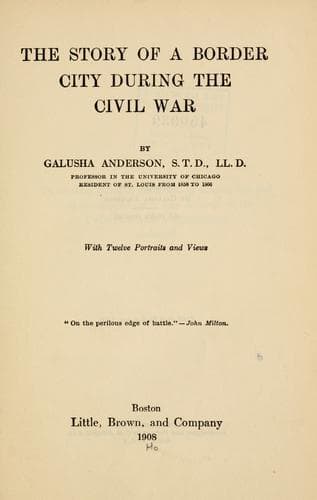
The story of a border city during the Civil WarAnderson, Galusha
History
The story of a border city during the Civil War
Anderson, Galusha
Missouri -- History -- Civil War, 1861-1865; Saint Louis (Mo.) -- History -- Civil War, 1861-1865
The hall was packed with spectators; and when the almost unanimous vote
for this ordinance was announced by the president they broke out into
loud applause; they swung hats, waved handkerchiefs, stamped, clapped
their hands and cheered. The president cried, “Order, order,” pounded
with his gavel and called on the sergeant-at-arms to suppress the
exultant uproar; but every effort was futile; he might as well have
attempted to still a hurricane by pounding on a board with a gavel and
by threatening it with an attack by one man armed. And how foolish it
was to try. For many years men in that shouting crowd had longed for
that hour; they had often feared that they should die without the sight.
And now that it had come in such unexpected ways their joy must have
vent. And in spite of all efforts to quiet them they continued to cheer
until they were exhausted. No wonder. The event that excited them was
great and significant. More than a hundred thousand slaves were in a
moment made freemen and the greatest obstacle to the progress of
Missouri was swept out of the way.
When at last the glad cries of the onlooking throng died away, Dr. Eliot
was called upon to voice the gratitude of all present by returning
thanks to Almighty God. He came to the president’s desk and from a full
heart poured out in tremulous tones this fitting petition:
“Most merciful God, before whom we are all equal, we look up to thee who
hast declared thyself our Father and our helper and our strong defence,
to thank thee that thou art no respecter of persons, to thank thee that
thou didst send Jesus Christ into the world to redeem the world from
sin, and that he was the friend of the poor, that he came to break the
manacles of the slaves, ‘that the oppressed might go free.’ We thank
thee that this day the people of this State have had grace given them to
do as they would be done by. We pray that thy blessing may rest upon the
proceedings of this Convention, that no evil may come to this State from
the wrong position of those who do not agree with the action of to-day,
but that we, all of us, may be united to sustain this which is the law
of the land. We pray, O God! but our hearts are too full to express our
thanksgiving! Thanks be to God for this day that light has now come out
of darkness, that all things are now promising a future of peace and
quietness to our distracted State. Grant that this voice may go over the
whole land until the Ordinance of Emancipation is made perfect
throughout the States. We ask it through the name of our dear Lord and
Redeemer. Amen.”
This prayer was followed by some moments of reverent silence; the hearts
of all present had been deeply touched. Then the hush that had fallen
alike on delegates and spectators was reluctantly broken. In subdued
tones a motion was offered that the Ordinance of Emancipation be
engrossed on parchment, attested by the secretary and signed by the
members of the Convention. This was unanimously adopted.
Public-domain text, read in full here on John Shaqi.
Reviews
Reviews
No reviews yet
Be the first to share your thoughts on this work.
Elsewhere in the archive
Join the Discussion
Join the discussion
Sign in to leave a comment or review.
Sign InorCreate an account