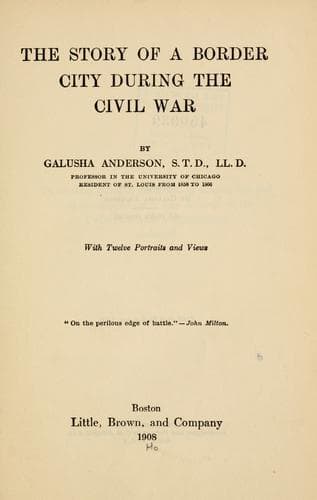
The story of a border city during the Civil WarAnderson, Galusha
History
The story of a border city during the Civil War
Anderson, Galusha
Missouri -- History -- Civil War, 1861-1865; Saint Louis (Mo.) -- History -- Civil War, 1861-1865
In the main the delegates were young. More than a third of them were
under forty, and more than two-thirds under fifty; none of them were
enfeebled by age. But a single glance at them convinced any intelligent
beholder that, taken as a whole, they were in capacity mediocre; and
most of them by their occupations had not been fitted to grapple with
questions that pertained to the fundamental law of the State. The people
who chose them had evidently not kept clearly in view the delicate and
difficult work that they would be called upon to perform. To a large
extent passion and prejudice born of the hour had controlled the voters
in their choice of delegates. In their anxiety to elect men who were
uncompromisingly in favor of immediate emancipation, they had not been
sufficiently careful in demanding that they should also be men qualified
to do their part intelligently in reconstructing the organic law of the
commonwealth.
Moreover, the Convention did not fairly represent the whole body of
loyal men in the State. Ruling out all downright rebels as justly
debarred from voting, the conservative anti-slavery element secured at
the best but a very small representation in this deliberative assembly.
The stringent oath of allegiance, framed by the old Convention and
rigidly required of every voter, kept many from making any attempt to
deposit their ballots; not because they were not, even under such a
severe test, legal voters, but because they shrank from the catechizing
to which they would be subjected at the polls by men who looked with
suspicion upon any one with conservative views.
Now when the Convention made up mainly of men holding ultra notions came
together and organized for work, choosing, at its second session, for
president, Arnold Krekel of St. Charles, a native of Prussia, an able
lawyer, but an extremist of the most pronounced type, all St. Louis was
agog. This first important act of the Convention unmistakably revealed
its radical drift, and showed how potent in it were the ultra political
notions of our German fellow-citizens. It proceeded at once to the
paramount business for which it had been created and called together,
the emancipation of the slaves of Missouri. On the fifth day after its
organization it passed, with only four votes in the negative, the
following ordinance:
“Be it ordained by the People of the State of Missouri, in Convention
assembled:
“That hereafter, in this State, there shall be neither slavery nor
involuntary servitude, except in punishment of crime, whereof the party
shall have been duly convicted; and all persons held to service or labor
as slaves are hereby declared free.”
Public-domain text, read in full here on John Shaqi.
Reviews
Reviews
No reviews yet
Be the first to share your thoughts on this work.
Elsewhere in the archive
Join the Discussion
Join the discussion
Sign in to leave a comment or review.
Sign InorCreate an account