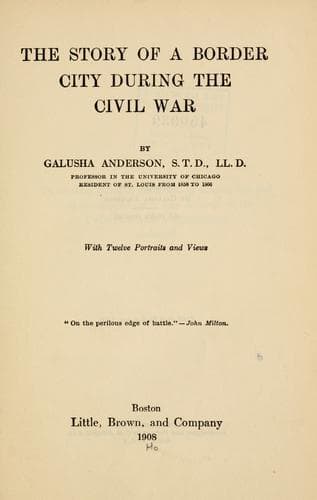
The story of a border city during the Civil WarAnderson, Galusha
History
The story of a border city during the Civil War
Anderson, Galusha
Missouri -- History -- Civil War, 1861-1865; Saint Louis (Mo.) -- History -- Civil War, 1861-1865
It would, however, be unjust to overlook the fact that there was in the
Convention a conservative minority, who steadily and sturdily fought
this extreme legislation. They contended that it was unjust to many in
the State; that, especially since the end of the war must be near, the
true policy was that of forgiveness and reconciliation; that those who
in spite of their Southern birth and education had, through bitter
experiences, become loyal, should not have their new-born faith crushed
out of them by this merciless oath; that the oath was a political
blunder since it would give all the enemies of the new Constitution some
just ground for their opposition to it. The debate was long and sharp.
Dr. Linton, a physician of our city, who had been a member of the first
Convention, while loyal to the core, distinguished himself by his strong
opposition to the oath. He had a genius for cogent, laconic speech. And
since Charles D. Drake, a Southerner by birth, was the pre-eminent
advocate of the oath and the author of most of its details, with grim
sarcasm he called it “the Draconian oath.” But the faithful minority
could not stem the tide of radicalism in the Convention and this
notorious oath became a part of the new Constitution of Missouri.
But we must cordially recognize the fact that the authors of it, and all
in the Convention who voted to make it part and parcel of the ground law
of the State, were genuinely patriotic. They sought not primarily party
ends, but the highest good of their commonwealth and of the entire
Republic. While they no longer doubted the favorable issue of the
terrible grapple of the Northern and Southern armies at Petersburg and
the Weldon Railroad, they clearly saw that this battle of blood would be
followed by a desperate political contest; that what disunionists should
fail to gain by the sword, they would endeavor to achieve by statecraft.
They were firmly persuaded that Missouri now faced her greatest peril;
that her future destiny trembled in the balance. If her old, corrupt
politicians, who, through necessity and with a sigh, had relinquished
their hold on slavery, should at once gain political ascendency, much,
if not all, that had been wrought out on the field of carnage, would be
hopelessly lost. The leaders of the Convention, with an accurate
knowledge of the situation, shaped its legislation effectively to meet,
if possible, the emergency. They framed this searching test oath to hold
in check the rebellious, pro-slavery element of the commonwealth, until
the new order of things should be thoroughly established. They were
firmly resolved that those who had striven with savage might to force
Missouri into secession, and link her to a Confederacy founded on
slavery, should not shape her future political character; that since God
had preserved the people in their passage through a sea of blood, the
taskmaster should not now lead them back to a worse than Egyptian
bondage.
Public-domain text, read in full here on John Shaqi.
Reviews
Reviews
No reviews yet
Be the first to share your thoughts on this work.
Elsewhere in the archive
Join the Discussion
Join the discussion
Sign in to leave a comment or review.
Sign InorCreate an account