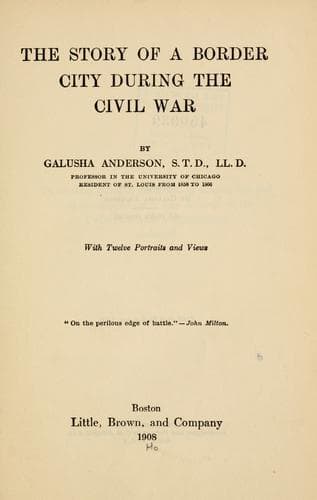
The story of a border city during the Civil WarAnderson, Galusha
History
The story of a border city during the Civil War
Anderson, Galusha
Missouri -- History -- Civil War, 1861-1865; Saint Louis (Mo.) -- History -- Civil War, 1861-1865
Whether the acts of the Convention were wise or unwise, the
whole drift of the Constitution framed by it clearly shows that this was
its sole and commendable object.
But after the Emancipation Act was passed, the Convention, having,
against the earnest protest of some of its own members, doggedly set
itself to the work of making a new Constitution, lost, to a large
extent, the confidence of many of the best loyal men of the State. Even
a goodly number of the delegates that composed it became to the extent
of their power obstructionists. Absenteeism grew apace, and only by the
rigid enforcement of the rules could the Convention be saved from
disastrous disintegration. Some of its members fell into a vein of
ridicule and one of them offered a string of satirical resolutions,
which, though unmitigated balderdash, the Convention complacently spread
on its minutes.
Most of the constituents of the Convention, while generously recognizing
the great merit of much of its work, were often ashamed of what it did
and said. In fact its debates were never published, beyond the brief and
imperfect reports of them in the daily papers. In explanation of this
curious fact, it was hinted that the leaders of the Convention were so
mortified by them, that they managed to suppress the whole, both good
and bad together.
The Convention, after dragging drearily on for seventy-eight days,
completed its work. It submitted the new Constitution which it had
wrought out to the suffrages of the people, that it might be by them
adopted or rejected. On the sixth of June it was ratified at the polls
by less than two thousand majority. This slender majority was in part
accounted for when, on analyzing the vote, it was found that the saner
radicals either stayed at home on election day or voted with the
opposition.
On the first day of July (1865) the Governor formally proclaimed the
vote for the adoption of the “Revised and amended Constitution,” and
declared that “it will take effect as the Constitution of the State of
Missouri, on the fourth day of the present month of July.” And while
this Constitution was not in all respects what the sanest minds
demanded, it contained so much that was progressive and admirable that
its rejection at that transitional epoch would have been a calamity.
While some parts of it were reprehensible, it embodied much of the most
advanced statesmanship of the day, and crystallized in fundamental law
what we had achieved by the war. It was progress made permanent.
Public-domain text, read in full here on John Shaqi.
Reviews
Reviews
No reviews yet
Be the first to share your thoughts on this work.
Elsewhere in the archive
Join the Discussion
Join the discussion
Sign in to leave a comment or review.
Sign InorCreate an account