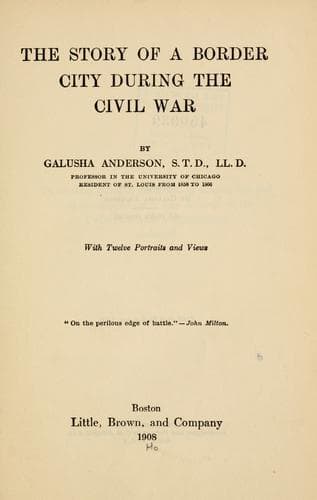
The story of a border city during the Civil WarAnderson, Galusha
History
The story of a border city during the Civil War
Anderson, Galusha
Missouri -- History -- Civil War, 1861-1865; Saint Louis (Mo.) -- History -- Civil War, 1861-1865
But as soon as the Constitution became operative, there was throughout
the State confusion, trouble and distress. No attorney, clerk of court,
judge of any grade, teacher male or female, deacon, elder or minister
was permitted to perform the duties which pertained to his profession or
office unless he had subscribed to the test oath. Hosts of those upon
whom this demand was made could not take it without perjury. If without
subscribing to it they ventured to do the duties which belonged to their
respective callings, they were liable to a fine of five hundred dollars
or to imprisonment in the county jail for not less than six months, or
to both; if they should take the oath falsely they would be adjudged
guilty of perjury, and punished by imprisonment in the penitentiary for
not less than two years. As was inevitable, arrests and indictments for
the violation of this statute were frequent. Its attempted enforcement
outraged and angered the people. A multitude of protests loud and bitter
came up from every part of the commonwealth. Sympathy was aroused
especially for those who had repented of their disloyalty, and now
ardently desired to serve their country, but in whose faces the new
Constitution shut and barred every door of forgiveness. Christian
pastors, especially of the Episcopal and Baptist churches, raised the
cry of persecution. But persecution was the very farthest from the
purpose of the framers of the Constitution. In their bill of rights they
set forth with great breadth and explicitness the doctrine of
unrestricted religious liberty. And in fact in the enforcement of the
test oath there was no religious persecution. No one was punished for
holding and promulgating any religious tenet. Moreover, the oath was
required of lawyers and school teachers as a prerequisite to their
duties as well as of ministers. Many ministers all over the State had in
one way or another supported the rebellion, and were now suffering for
that and nothing else.
Public-domain text, read in full here on John Shaqi.
Reviews
Reviews
No reviews yet
Be the first to share your thoughts on this work.
Elsewhere in the archive
Join the Discussion
Join the discussion
Sign in to leave a comment or review.
Sign InorCreate an account