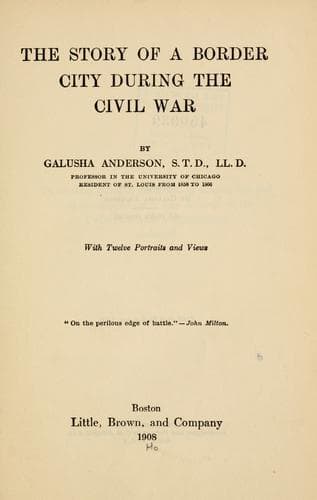
The story of a border city during the Civil WarAnderson, Galusha
History
The story of a border city during the Civil War
Anderson, Galusha
Missouri -- History -- Civil War, 1861-1865; Saint Louis (Mo.) -- History -- Civil War, 1861-1865
It was April 10th, 1865, the last day of the Constitutional Convention.
As, in the morning, the Convention began listlessly and wearily to do
the formal and necessary things before its final adjournment, a telegram
was received announcing the surrender of General Lee on the preceding
day to General Grant at Appomattox. The effect was electric. In a flash
all dulness and languor fled. For the nonce all differences of opinion
vanished. All hearts were surcharged with patriotic emotion. The die was
cast. The integrity of the Union was assured. From all parts of the hall
came shouts of joy; delegates and spectators vied with each other in
expressions of gladness. They clapped, stamped and cried, “The Union
forever!” Mr. Drake, the leader of the Convention, finally got the ear
of the rejoicing patriots and gravely moved that they give cheers three
times three “for the glorious news just now received.” They were given
with full lung power. Those nine hurrahs brought the members of the
Convention to quietude once more, and they proceeded by resolution to
thank “Almighty God for the success of our noble and patriotic army and
navy; for the steady and persistent perseverance of our noble President
in the work of breaking the power of the rebellion; and especially for
the noble and humane disposition which has been manifested by our
authorities to our conquered enemy.” But they also declared, that they
were not ready “to sanction any terms of peace which will admit of the
perpetuation of slavery in any part of the Republic.” While this last
resolution was well enough as an expression of opinion, it showed, at
the very last, a disposition on the part of the Convention to get beyond
its jurisdiction and attempt to shape the policy of the general
government. Its remaining routine work was soon done. Its life ended.
But the city and State, rejoicing over the close of the war, scarcely
noted it. Those who did notice its termination were twice glad; glad
that it had adjourned _sine die_ and that national peace, founded in
justice, had come.
Public-domain text, read in full here on John Shaqi.
Reviews
Reviews
No reviews yet
Be the first to share your thoughts on this work.
Elsewhere in the archive
Join the Discussion
Join the discussion
Sign in to leave a comment or review.
Sign InorCreate an account