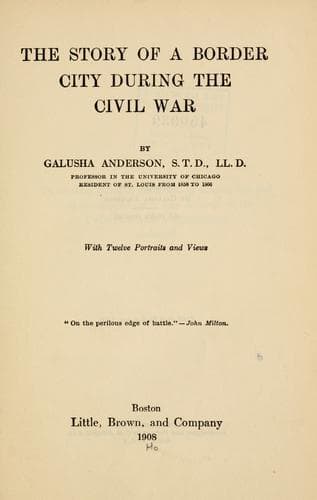
The story of a border city during the Civil WarAnderson, Galusha
History
The story of a border city during the Civil War
Anderson, Galusha
Missouri -- History -- Civil War, 1861-1865; Saint Louis (Mo.) -- History -- Civil War, 1861-1865
That 10th of April was memorable not only for the whole nation, but also
especially for St. Louis. A border city, which, for four long years, had
been a bone of contention, fought over and snarled over by the dogs of
war, had perhaps a keener appreciation of the surrender of the
illustrious Lee, than could be found in any city far to the north of
Mason and Dixon’s line. At all events no pen however able and eloquent
could adequately depict our joy on the day which followed Grant’s final
victory in Virginia. No business was done, except that which was most
necessary and perfunctory. Men spontaneously gathered in crowds, their
faces radiant, their lips rippling with smiles; they shook hands with
firm grip; with tears starting in their eyes they talked of the
surrender; all bitterness seemed to be gone; there was little or no
exultation over those who had laid down their arms; men on every hand
just brimmed over with gladness that the fratricidal strife had ended,
and that slavery, the fruitful cause of our greatest woes, was no more.
And it was remarkable how few secessionists there were in our city on
that day. During the four preceding years they had been alarmingly
numerous, but now only a very few could be found; they had been
strangely and magically transformed into Unionists. Even those who for
four years had sat on the fence hopped off on the Union side, flapped
their wings and crowed.
Still our city was not a unit in political thought and sentiment. While
Grant’s victory caused the great multitude to rejoice, it was wormwood
and gall to the few, who, in spite of disaster to the Confederacy, were
still faithful to it. While their neighbors were exultant, they bitterly
mourned. The city put on its gala dress. Public buildings and private
dwellings were lavishly decorated with red, white and blue. National
flags of all sizes were flung to the breeze. But here and there a house
was flagless. Within sat sad and sombre secessionists sighing over their
shattered hopes. They refused to be comforted. At night once more the
bells rang, bands played, bonfires blazed, cannon boomed, and the
windows of most buildings, public and private, were illuminated; while
in public halls the people gathered to listen to patriotic speeches and
to sing the most popular and stirring war songs. “The Star Spangled
Banner,” “Rally Round the Flag, Boys,” and “The Soul of Old John Brown,”
had a large place in our festivity, while “My Country, ’Tis of Thee,”
was sung as the crowning and parting hymn.
Public-domain text, read in full here on John Shaqi.
Reviews
Reviews
No reviews yet
Be the first to share your thoughts on this work.
Elsewhere in the archive
Join the Discussion
Join the discussion
Sign in to leave a comment or review.
Sign InorCreate an account