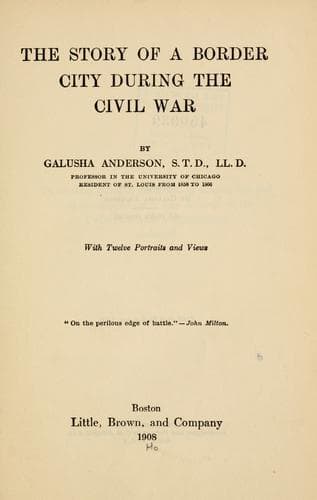
The story of a border city during the Civil WarAnderson, Galusha
History
The story of a border city during the Civil War
Anderson, Galusha
Missouri -- History -- Civil War, 1861-1865; Saint Louis (Mo.) -- History -- Civil War, 1861-1865
Throughout the city all flags were at half-mast. On public buildings,
churches and private dwellings, the emblems of rejoicing gave place to
those of mourning. Public sentiment was such that no one living in the
better part of the residential districts dared to withhold the ordinary
tokens of the general sorrow. Houses that five days before were
conspicuously dark amid the almost universal illumination were now
draped in black; some it may be in self-defence, but probably in most
cases as the expression of genuine sorrow. Though the Confederacy for
which the secessionists of our city had worked and prayed was
irretrievably lost, they had at least come to respect Mr. Lincoln, not
only for his unswerving fidelity to what he believed to be the right,
but also for his broad charity, and not a few of them, while still
differing from him politically, admired him as a man. They recognized in
him a great and generous friend of the South, and so joined with us, on
that day of tears, in eulogizing the martyr and denouncing his assassin.
The same lips that four years before had scornfully called him clown,
the Illinois ape, baboon and gorilla, now praised him. He had not only
subdued the rebellion by force of arms, but also by his clearness of
conception, fairness in administration, unflinching advocacy of the
rights of all, patience and persistence in duty, and large-heartedness,
had conquered their inveterate prejudices.
In the afternoon of that day of sorrow, the churches were thrown open,
and large congregations met to pray. They poured out their hearts in
thanksgiving to God for the unsullied life of the martyred President;
for his courage and wisdom in proclaiming liberty to the captive, and
freedom to the oppressed. They prayed for his constitutional successor
in office, and for God’s blessing on the people both North and South.
Nor did they forget the assassin whose wanton act had bowed a nation in
grief. In all their utterances they were calm and sane, as men always
are when, in submission to the will of God, they commune with Him. At
last the curtain of darkness fell on that terrible day, and men with
throbbing brows and aching hearts lay down to rest; but to many, if
sleep came at all, it came but fitfully. We seemed to be living in a new
world. One era of our national life had ended, another had begun. And
with ever new experiences our mourning was prolonged as from day to day
with the whole Republic we followed in thought the dust of the immortal
martyr to its last resting-place at Springfield, Illinois. It was most
fitting that it should lie near the home of his early manhood, and in
the State that he, in larger measure than any other, had made
illustrious.
Public-domain text, read in full here on John Shaqi.
Reviews
Reviews
No reviews yet
Be the first to share your thoughts on this work.
Elsewhere in the archive
Join the Discussion
Join the discussion
Sign in to leave a comment or review.
Sign InorCreate an account