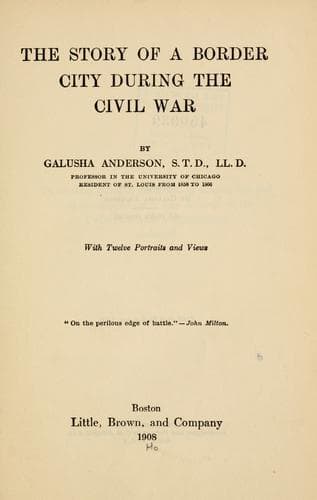
The story of a border city during the Civil WarAnderson, Galusha
History
The story of a border city during the Civil War
Anderson, Galusha
Missouri -- History -- Civil War, 1861-1865; Saint Louis (Mo.) -- History -- Civil War, 1861-1865
Thirty days after the assassination of Mr. Lincoln, the Baptist
Missionary Societies of the North held, by urgent invitation, their May
Meetings in our city. This had been made possible by the war. The
churches of this great denomination had long been divided by slavery;
but now the delegates from the churches of the North came to hold out
the olive branch to their brethren of the South on what had been slave
soil. They came by hundreds. The city gave them a royal welcome.
Christians of all denominations threw open their doors to them and
lavished upon them their hospitality. It was an era of good feeling.
Denominationalism and the irritating questions of the war decidedly fell
into the background.
But there was another side to the picture. Southern Baptists, except
from the national capital, did not come to us. The olive branch seemed
to be held out in vain. The brotherly act was even misconstrued. The
coming of these Northern missionary societies to our city was regarded
as an unwarrantable invasion of Southern soil. Forty years had to pass
away, a generation had to die in the wilderness, before, in St. Louis,
during the progress of the May Meetings of the same societies, Northern
and Southern Baptists, standing face to face, truly fraternized with
each other and sang heartily:
“Blest be the tie that binds
Our hearts in Christian love.”
There was one unique incident at the meetings in 1865, that deserves
special notice. The name of the martyred President was on all lips. Men
were just beginning to understand and appreciate something of his
greatness, both of mind and heart. It was whispered in the ears of our
guests that an artist of our city, A. J. Conant, had painted, from
sittings, a portrait of Mr. Lincoln. He was invited to unveil this
portrait before the assembled delegates. He did so. A great and
distinguished company greeted it with enthusiasm and cheers; and were
specially delighted to hear the artist’s account of what the great
President did and said while he kindly sat for his portrait,—what quaint
and suggestive stories he told. The portrait was painted before Mr.
Lincoln’s first inauguration. His face was then smooth shaven. He had
not yet covered up with scraggly whiskers the rugged outlines of his
lower jaw, which, from a side view, as some one has said, was shaped
like the keel of a three-masted schooner.[114] It is doubtful if any one
has produced a better portrait of that strong face with its undertone of
sadness.
Public-domain text, read in full here on John Shaqi.
Reviews
Reviews
No reviews yet
Be the first to share your thoughts on this work.
Elsewhere in the archive
Join the Discussion
Join the discussion
Sign in to leave a comment or review.
Sign InorCreate an account