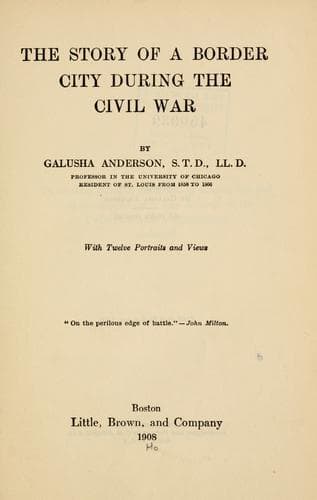
The story of a border city during the Civil WarAnderson, Galusha
History
The story of a border city during the Civil War
Anderson, Galusha
Missouri -- History -- Civil War, 1861-1865; Saint Louis (Mo.) -- History -- Civil War, 1861-1865
“And then, if I heard correctly, we are threatened with disaster if we
now vote against permitting this seceding synod to depart in peace. But
shall we by threats be deterred from our duty? Having already cut off
the seven hydra heads of secession, shall we now be frightened with the
wriggle of its tail?”
This was the climax. There was long continued laughter and applause,
which the moderator was unable to check. Peaceable secession found no
more favor in this Presbyterian Convention than it had found under the
general government of the United States. Secession was dead.
At last the end of strife in Missouri had come. It came in fact even
before the surrender of Lee. Three days after the second inauguration of
Mr. Lincoln, Governor Fletcher declared by proclamation that no
organized armed force against the general government any longer existed
in the State. He called upon all civil officers to resume their duties.
And on the 17th of March, Major-General Pope, then in command of the
Department of Missouri, issued orders to aid in carrying out the
proclamation of the Governor. He withdrew the military forces from all
districts where the people were ready to return in good faith to civil
rule, and by August there remained less than a dozen military posts in
the State; and these were kept up chiefly for the protection of the
property of the Federal government.
And now rejoicing in peace which was based upon righteousness, St. Louis
entered upon an era of great prosperity. She grew apace in commerce,
wealth and population. No longer, as Carl Schurz characterized her
before the war, “a free city on slave soil,” but a great free city on
free soil.
THE END.
INDEX
Abolitionists, denounced, 48;
alleged atrocious conduct of, 54;
hated, 161;
two extraordinary, 170–176;
as viewed by Southerners, 252.
Alabama, Governor of, urges secession, 23, 33.
Alton, Illinois, arms landed at, 79;
murder of Lovejoy at, 80;
fugitives from panic in Saint Louis flee to, 111.
Public-domain text, read in full here on John Shaqi.
Reviews
Reviews
No reviews yet
Be the first to share your thoughts on this work.
Elsewhere in the archive
Join the Discussion
Join the discussion
Sign in to leave a comment or review.
Sign InorCreate an account