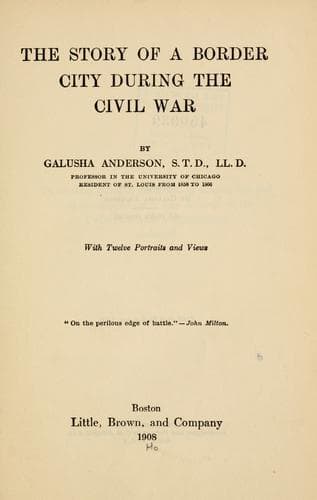
The story of a border city during the Civil WarAnderson, Galusha
History
The story of a border city during the Civil War
Anderson, Galusha
Missouri -- History -- Civil War, 1861-1865; Saint Louis (Mo.) -- History -- Civil War, 1861-1865
A little later the Presbyterians held a convention in our city. This too
was an outcome of the war. In May, their General Assembly at Pittsburg
had enacted some severe and radical measures in reference to slavery and
loyalty to the national government. Many Presbyterians, especially of
the border States, protested against this. The convention was called to
consider the whole question. There were over two hundred delegates,
mainly from the North; probably not a score of them were from the border
States, including Missouri.[115] The aggrieved States were very slimly
represented. The synod of Missouri was so opposed to the legislation of
the General Assembly as to ask permission peaceably to withdraw from it.
Their request was very earnestly debated. A pastor from Brooklyn, N. Y.,
joined hands with a pastor of St. Louis in behalf of the recalcitrant
synod, urging, by great ingenuity of argument, that the synod should be
permitted unmolested to secede. In their impassioned appeals on behalf
of the aggrieved synod they were at times so eloquent that the galleries
burst out into applause. The ladies waved their handkerchiefs. The style
of the brother from our city was often quite flowery. These two
defenders of the refractory synod sometimes complained in their speeches
that they were not being fairly dealt with, and posed as martyrs; at
other times their language became somewhat threatening.
But at last a Scotchman from Ohio got the floor. His speech was replete
with mingled humor and sarcasm. The delegates and spectators were at
times convulsed with laughter. Among other things he said, with a
decided Scotch accent, “Mr. Moderator, the brethren who have defended
the synod that wishes to secede have posed as martyrs. What is a martyr?
In the time of the early church it was one who suffered for the truth
which he believed and advocated. He was thrown to wild beasts and was
torn limb from limb; or he was sewed in a sack and thrown into the
Tiber, or he was burned at the stake. But what is a modern martyr? It is
to live on Brooklyn Heights and be sent to Europe for the bronchitis.” A
too personal thrust at the delegate from Brooklyn. “What is a modern
martyr? It is to make an eloquent speech in an assembly like this and
have the fair in the galleries wave their handkerchiefs. But the speech
of the brother from this city brought to my mind an experience of my
school days. I wrote an oration and handed it to my teacher for
correction. When he had examined it he called me to him and said,
‘Taylor, if you would only pluck a few feathers from the wings of your
imagination and stick them into the tail of your judgment, you would
write a great deal better.’
Public-domain text, read in full here on John Shaqi.
Reviews
Reviews
No reviews yet
Be the first to share your thoughts on this work.
Elsewhere in the archive
Join the Discussion
Join the discussion
Sign in to leave a comment or review.
Sign InorCreate an account