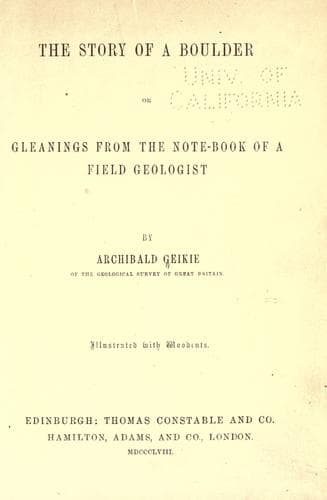
The Story of a Boulder; or, Gleanings from the Note-book of a Field GeologistGeikie, Archibald
Science
The Story of a Boulder; or, Gleanings from the Note-book of a Field Geologist
Geikie, Archibald
Geology; Petrology
In the autumn of 1832, the attention of the scientific public of
Edinburgh was directed to the extraordinary character of some fossil
remains obtained from the lime-quarries of Burdiehouse, a village about
four miles to the south of the town. Dr. Hibbert visited the locality,
and soon saw enough to excite his lively interest in its thorough
investigation. The Royal Society of Edinburgh warmly supported his
exertions, and by their means a large suite of specimens was eventually
obtained, which the Doctor from time to time described as they were
successively received. At the meeting[45] of the British Association in
Edinburgh, in 1834, the specimens were exhibited before the Geological
Section, and a memoir upon them read by their successful discoverer.
On the conclusion of the paper, a lively discussion ensued upon the
nature of the animal to which the scales and teeth had belonged.
Dr. Hibbert argued, from the deeply-furrowed teeth, and the strong,
massive cranial plates, that the animal must have been a reptile, and
supported his assertion by no small amount of anatomical skill. In the
midst of the discussion, a message was sent to the great ichthyologist
of Neufchatel, who happened to be at that time busily engaged in the
Zoological Section. Passing over the fossils as they lay grouped
upon the table, with that quick perception for which he is so justly
celebrated, Agassiz at once decided that the bones must have been
those of some large and hitherto undescribed _fish_. Such a decision
from such an authority produced of course no little sensation, and the
naturalist was told with some surprise that the remains had just been
elaborately described as those of extinct reptiles. "Reptiles!" thought
Agassiz, and again his quick eye darted over the table; but the fossils
would yield no other answer than what they had already given. Despite
their seeming reptilian character, they were undoubtedly ichthyic,
though belonging to an animal up to that time unknown. In the completed
memoir which Dr. Hibbert subsequently submitted to the Royal Society,
his mistake was freely acknowledged, and the remains there flourish as
those of a true fish. But with this amendment a grave error of another
kind was committed, though in this the Doctor seems to have been
supported by the authority of Agassiz himself. The large bones, scales,
and teeth of the Burdiehouse limestone, were all indiscriminately
thrown into one genus, to which Agassiz gave the name of Megalichthys;
and in the memoir we find the different kinds of scales and teeth
described and figured without the slightest intimation or suspicion
that they might possibly have belonged to different animals. The
novelty of the discoveries soon attracted general attention to
Dr. Hibbert's paper. It was quoted or referred to in almost every
scientific work treating of general geology, while in some instances
(as in Dr. Buckland's _Bridgewater Treatise_) the erroneously-named
bones were re-engraved.
Public-domain text, read in full here on John Shaqi.
Reviews
Reviews
No reviews yet
Be the first to share your thoughts on this work.
Elsewhere in the archive
Join the Discussion
Join the discussion
Sign in to leave a comment or review.
Sign InorCreate an account