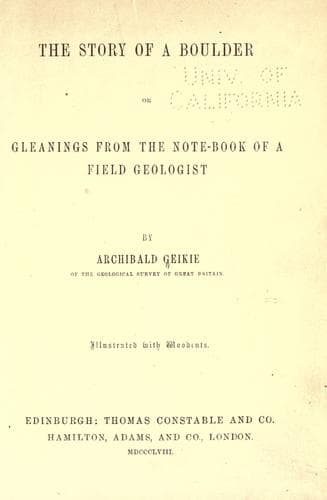
The Story of a Boulder; or, Gleanings from the Note-book of a Field GeologistGeikie, Archibald
Science
The Story of a Boulder; or, Gleanings from the Note-book of a Field Geologist
Geikie, Archibald
Geology; Petrology
a loose open network of cancellated bone that passes into the layer on
either side, and resembles in its general texture the osseous vertebræ
of the same fish. The under layer, one end of which rested immediately
on the skin, approaches more to the firmness and solidity of the outer
one, but, in place of a tessellated, ivory-like pavement, it had a
close fibrous texture, with here and there a scattered cavity, and the
fibres were matted together so as to resemble the more solid structure
of the cranial bones. The effect of this triple arrangement must have
been to impart great strength and lightness to the external armature
of the fish; the middle spongy layer serving, by its porosity, at once
to deaden the effect of any blow aimed at the outside, and to give
buoyancy and lightness to what would otherwise have been a coat of
mail well-nigh, as ponderous as that of a feudal chief. One can hardly
conceive any implement of warfare in use among the lower animals of
strength enough to pierce this massive covering. But we shall find
as we go on that if the megalichthys had a strong defensive armour,
a bulkier neighbour had a still stronger offensive one, and that the
enamelled plates of the one fish were scarcely a match for the huge
pointed tusks of the other.
The megalichthys had an osseous skeleton, with vertebræ of a discoidal
form. These internal bones when viewed under the microscope are found
to display an open cancellated structure, resembling that of the
central layer in the scales. It thus appears that this ancient fish
was not merely defended by a hard external armour, but possessed an
equally solid framework of bone within.
Mingled with the scales and bones of the megalichthys, there are found
the remains of a still larger fish, to which the name of Holoptychius
has been given. Its external ornament differed entirely from that of
the animal last described. It possessed teeth sometimes six or seven
times larger, and jaws, plates, and bones of a form and dimensions
totally distinct. Strange as it may seem, however, these two fishes
have been constantly and systematically confounded from the time when
they were first discovered. Two or three years ago, there might be
seen in the British Museum several specimens of the holoptychius,
of which some bore the correct name, while the rest were labelled
"Megalichthys;" and a similar error prevailed in several of the other
museums.[44] The confusion can be traced very distinctly in the memoir
of Dr. Hibbert, who for the first time described the remains of these
fishes, and wrote according to information received from Agassiz.
[Footnote 44: The mistake was noticed in 1845 by Hugh Miller, who, in a
foot-note to his _First Impressions of England and its People_, p. 71,
well defines the distinctions between the two ichthyolites.]
Public-domain text, read in full here on John Shaqi.
Reviews
Reviews
No reviews yet
Be the first to share your thoughts on this work.
Elsewhere in the archive
Join the Discussion
Join the discussion
Sign in to leave a comment or review.
Sign InorCreate an account