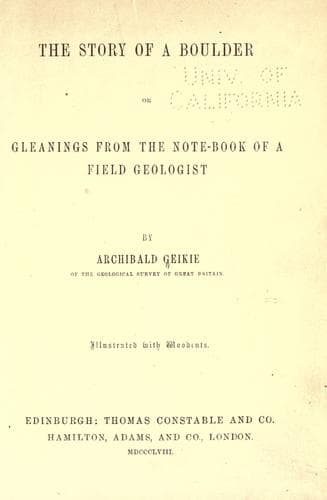
The Story of a Boulder; or, Gleanings from the Note-book of a Field GeologistGeikie, Archibald
Science
The Story of a Boulder; or, Gleanings from the Note-book of a Field Geologist
Geikie, Archibald
Geology; Petrology
From the blackened plants that darkened the upper layers of the
boulder, the transition was natural to the matrix in which they lay.
The whole rock consisted of a fine quartzy sand more or less distinctly
laminated, and showing in its lower parts well-rounded pebbles of
quartz, green grit, and felspathic trap. The contemplation of these
features suggested the existence of some old land with elevated ranges
of hills, and wide verdant valleys traversed by rivulets and rivers
which bore a ceaseless burden of mud, sand, and gravel, onwards to
the sea. The pebbles afforded some indication of the kind of rocks
that formed the hill-sides. Perhaps the higher grounds exhibited that
grey wrinkled appearance peculiar to the quartz districts of the
north-western Highlands, with here and there a bluff crag of felspathic
trap shooting up from among the fern-brakes of the valley, or cutting
across the channel of some mountain stream that tumbled over the pale
rock in a sheet of foam. And there may have been among these uplands
smooth undulating districts, dotted over with dark araucarian pines,
and densely clothed with a brushwood of rolling fern, but which showed
in all their ravines the green grit that formed the framework of the
country,--its beds twisted and contorted, jointed and cleaved, like
the grits and slates along the banks of many a stream, beloved by
the angler, in the classic ground of the Ettrick and the Yarrow. But
whatever may have been the special features of its scenery, there can
be no doubt of the land's existence. The carbonized plants stand up to
tell us of its strange and luxuriant vegetation. We have listened to
their story, and suffered them to lead us away into forest, and lake,
and sea, to look on the various forms of life, vegetable and animal,
which abounded in that far-distant age. We return again to the boulder,
and shall now seek to learn the lessons which the sand and pebbles have
to teach us. Their subject belongs to what is called physical geology,
and will bring before us some of the more mechanical operations of
nature, such as the slow but constant action of air, rain, and rivers,
upon hard rock, the grinding action of the waves, and the consequent
accumulation of new masses of sedimentary rock.
In all the departments of nature that come under the cognizance of man,
there is seen to be an endless succession of mutations. According to
the Samian philosopher--
"Turn wheresoe'er we may by land or sea,
There's nought around us that doth cease to be.
Each object varies but in form and hue,
Its parts exchange; hence combinations new.
And thus is Nature through her mighty frame
For ever varying, and yet still the same."
Public-domain text, read in full here on John Shaqi.
Reviews
Reviews
No reviews yet
Be the first to share your thoughts on this work.
Elsewhere in the archive
Join the Discussion
Join the discussion
Sign in to leave a comment or review.
Sign InorCreate an account