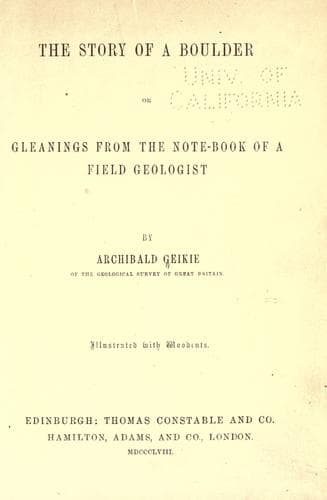
The Story of a Boulder; or, Gleanings from the Note-book of a Field GeologistGeikie, Archibald
Science
The Story of a Boulder; or, Gleanings from the Note-book of a Field Geologist
Geikie, Archibald
Geology; Petrology
In the world of life we see how animals are sustained by a constant
series of chemical changes in their blood, every respiration of air
adding, as it were, fresh fuel to the flame of life within. In plants,
too, there is an analogous process. The atmospheric air is by them
decomposed, part of it being given off again, and part retained to
build up the organic structure. Plants withdraw mineral matter from the
soil, animals feed upon plants, and thus the earthy substances, after
having formed a part, first of rock masses, then of vegetable, and
subsequently of animal organizations, are returned again to the soil,
whence to be once more withdrawn and undergo new cycles of mutation.
But this perpetual interchange is not confined to the vital world. We
see it in the action of winds, when heated air rises and moves in one
direction, and the colder parts sink and travel the opposite way. The
same principle is exhibited by the oceanic currents, the removal of a
body of water, from whatever cause, always necessitating the ingress of
a corresponding quantity to supply its place. But perhaps one of the
most beautiful instances of these interchanges in the whole inorganic
world is the ceaseless passage of water from the land to the sea, and
from the sea to the land. The countless thousands of rivulets, and
streams, and gigantic rivers, that are ever pouring their waters into
the great deep, do not in the least raise its level or diminish its
saltness. And why? Simply because the sea gives off by evaporation
as much water as it receives from rain and rivers. The vapour thus
exhaled ascends to the upper regions of the atmosphere, where it forms
clouds, and whence it eventually descends as rain. The larger part of
the rain probably falls upon the ocean, but a considerable amount is
nevertheless driven by winds across the land. This finds its way into
the streams, and so back again to the sea, only, however, to be anew
evaporated and sent as drizzling rain across the face of land and sea.
This interchange is constantly in progress, and seems to have been as
unvarying during past ages.
But the ceaseless passage of water between land and sea is not a mere
isolated and independent phenomenon. Like all the rest of Nature's
processes, even the simplest, it produces important and complicated
effects. And the reader may, perhaps, think it worth looking at for a
little, when he reflects that to this seemingly feeble cause we owe no
small part of our solid lands, whether as islands wasted by the sea,
or as part of vast and variegated continents, wide rolling prairies
covered with verdure and roamed over by herds of cattle, or wintry
Alpine hills lifeless and bare.
Public-domain text, read in full here on John Shaqi.
Reviews
Reviews
No reviews yet
Be the first to share your thoughts on this work.
Elsewhere in the archive
Join the Discussion
Join the discussion
Sign in to leave a comment or review.
Sign InorCreate an account