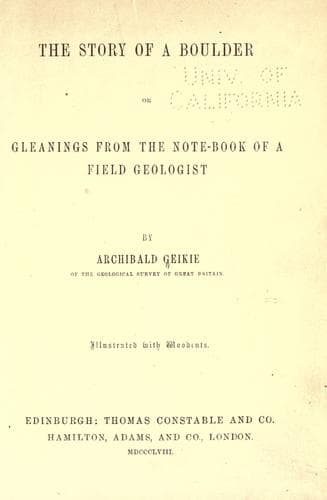
The Story of a Boulder; or, Gleanings from the Note-book of a Field GeologistGeikie, Archibald
Science
The Story of a Boulder; or, Gleanings from the Note-book of a Field Geologist
Geikie, Archibald
Geology; Petrology
There we see process dove-tailing with process, and spreading
out over the material world in an endless network of cause and effect.
We feebly try to trace out these interlacing threads, but we can follow
them far in no direction. Proteus-like, they seem to change their
aspect, blending now into one form, now into another, and so eluding
our keenest pursuit.
[Footnote 51: Cicero, _De Nat. Deor._ lib. i. 4. So, in Bacon's _Wisdom
of the Ancients_, under the fable "Pan or Nature:"--"The chain of
natural causes links together the rise, duration, and corruption; the
exaltation, degeneration, and workings; the processes, the effects,
and changes, of all that can any way happen to things." Such is the
philosopher's explanation of the Destinies as sisters of Pan. In no
part of his writings can the thorough practical character of Bacon's
philosophy be more conspicuously seen than in his treatment of these
ancient fables. Glancing over the titles of the different papers, you
are tempted to wonder what an intellect which could only appreciate
poetry as a mode of narrating history or as a vehicle for the teaching
of truth, will make of such fairy tales as those of Pan, Orpheus,
Proteus, Cupid, and many others. They seem like so many airy Naiads
crushed within the iron grasp of a hundred-banded Briareus. But a
perusal of those delightful pages will show that the giant has really
no malevolent intentions towards his fair prisoners; nay, that he only
wishes, by stripping them of their paint and finery, to show that,
with all their lightness and grace, they are nevertheless strong buxom
dames, of the same doughty race with himself.]
As an instance, therefore, of this remarkable interlacing of different
causes in what we call a single process, the disintegration of rocks
deserves our attention. In ordinary language, we say a stone rots
away, and its debris is washed down by the rains and streamlets, and
the process does not at first sight seem at all more complex than the
expression used to describe it; yet if we examine the subject, we shall
ere long find that there are in nature many simpler things than the
rotting away of a stone. To effect such a result, there come into play
a whole category of agencies, chemical and mechanical, so combined in
their operation, and so intimately blended in their effects, that it
becomes no easy task to tell where one set ends and another begins.
Public-domain text, read in full here on John Shaqi.
Reviews
Reviews
No reviews yet
Be the first to share your thoughts on this work.
Elsewhere in the archive
Join the Discussion
Join the discussion
Sign in to leave a comment or review.
Sign InorCreate an account