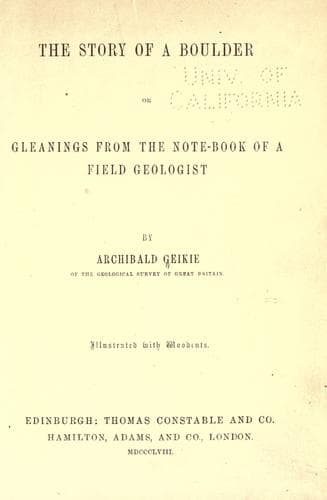
The Story of a Boulder; or, Gleanings from the Note-book of a Field GeologistGeikie, Archibald
Science
The Story of a Boulder; or, Gleanings from the Note-book of a Field Geologist
Geikie, Archibald
Geology; Petrology
The truth of this will appear when we reflect that the moisture which
rises from the sea and falls on the land as rain, is free from any
admixture of impurities; but by the time it again reaches the sea,
after a circuit of perhaps many miles down valley and plain, it has
grown turbid and discoloured, carrying with it a quantity of mud, sand,
and drift-wood. The sediment thus transported soon sinks to the bottom,
where it eventually hardens into rock, and in course of time is raised
above the waves as part of a new land. Such I conceive to have been the
origin of the sand, gravel, and imbedded plants of our boulder. It may
be well, however, in going into the details of the subject, to take a
wider view of this interesting branch of geology, and look for a little
at the forms and modes of the decomposition of rocks, and the varied
manner in which new sedimentary accumulations are formed.
All over the world, wherever a land surface spreads out beneath the
sky, there goes on a process of degradation and decay. Hills are
insensibly crumbling into the valleys, valleys are silently eroded,
and crags that ever since the birth of man have been the landmarks of
the race, are yet slowly but surely melting away. It matters not where
the hill or plain may lie, the highest mountains of the tropics and
the frozen soil of the poles, yield each in its measure and degree
to the influence of the general law. It might seem that so universal
a process should be the result of some equally prevalent and simple
cause. But when we set ourselves to examine the matter, we find it far
otherwise. The waste of the solid lands, in place of arising from some
single general action, is found to result from a multiform chain of
causes, often local in their operation and variable in their effects.
Such an investigation affords a good illustration of the general mode
and fashion in which Nature delights to work. It shows us that what
may seem a very simple process may be in reality a very complicated
one; that in truth there exist in the world around us few if any
simple, single processes, which stand out by themselves unconnected
with any other; that, on the contrary, all become intimately linked
together, the effects of one often forming part of the chain of causes
in another, and producing by their combined action that complex yet
strikingly harmonious order that pervades all the operations of Nature.
To an extent of which Cicero never dreamed, there runs through all
the world "such an admirable succession of things that each seems
entwined with the other, and all are thus intimately linked and bound
together."[51] Man separates out these various processes, classifies
and arranges them, because from the imperfection of his mental powers
he cannot otherwise understand their effects; all would seem but
chaos and confusion. But the formal precision and the sharp lines of
demarcation exist only in his mind. They have no place in the outer
world.
Public-domain text, read in full here on John Shaqi.
Reviews
Reviews
No reviews yet
Be the first to share your thoughts on this work.
Elsewhere in the archive
Join the Discussion
Join the discussion
Sign in to leave a comment or review.
Sign InorCreate an account