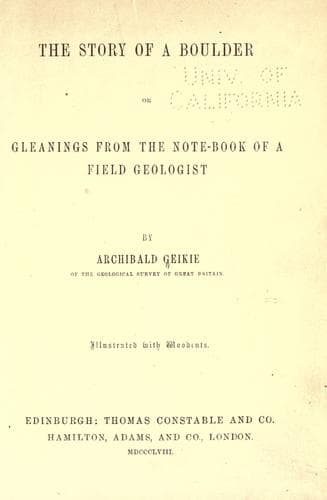
The Story of a Boulder; or, Gleanings from the Note-book of a Field GeologistGeikie, Archibald
Science
The Story of a Boulder; or, Gleanings from the Note-book of a Field Geologist
Geikie, Archibald
Geology; Petrology
ingredients, they produce no slight amount of physical change on the
surrounding districts, and must be regarded as important geological
agents.
But perhaps the most common and widely-diffused form of decomposition,
is that produced on the surface of the earth by the action of
rain-water, in slowly dissolving out the soluble parts of rocks, and
washing away the loose, incoherent grains that remain behind. It is
hard to say whether this process is more chemical or mechanical.
The solution of the mineral matter belongs to the former class of
changes, while the removal of debris must be ranked among the latter.
The results of these combined forces form one of the most important
branches of investigation which can occupy the attention of the
physical geologist, and in contemplating them, we are at a loss whether
most to admire their magnitude, or the immense lapse of time which
they must have occupied. It may be worth while to look at the progress
of this kind of disintegration, that we may see how wide-spread and
constant is the waste that goes on over the world, and how materially
the effects of running water are by this means increased. A volume
might be written about the decay of rocks, and a most interesting one
it would be, but its authorship would devolve rather on the chemist
than the geologist.[52] We can do no more here than merely glance at
one or two illustrative examples.
[Footnote 52: A German chemist, Bischoff by name, has written two
learned volumes in which this subject is discussed (translated into
English, and published by the Cavendish Society), valuable for their
facts, but not always very safe in their deductions.]
Among the mineral substances that most readily yield to the action of
the weather, are the silicates and the carbonates. The rocks containing
the former belong in large measure to what we call the igneous class,
such as the granites and traps; while those containing the latter
form the bulk of our useful stones, such as limestone and sandstone.
The removal of alkaline silicates is due to their conversion into
carbonates, which are readily soluble in water. Rain falling on a rock
in which they are largely present, dissolves a small portion, and
carries it into the soil or into streams, and thence to the ocean.
Every shower in this way withdraws a minute amount of mineral matter,
and tends to leave the harder insoluble grains of the rock standing out
on the surface in the form of a loose pulverulent crust, easily washed
away. The debris thus formed, where allowed to accumulate, makes an
excellent kind of soil known to the Scottish farmers as "rotten rock."
Public-domain text, read in full here on John Shaqi.
Reviews
Reviews
No reviews yet
Be the first to share your thoughts on this work.
Elsewhere in the archive
Join the Discussion
Join the discussion
Sign in to leave a comment or review.
Sign InorCreate an account