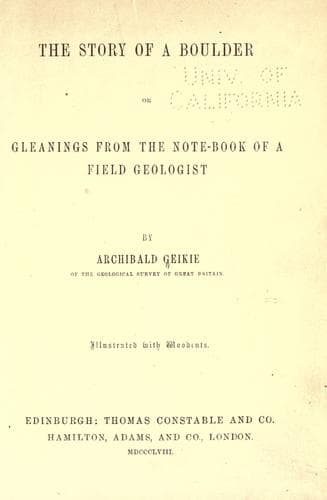
The Story of a Boulder; or, Gleanings from the Note-book of a Field GeologistGeikie, Archibald
Science
The Story of a Boulder; or, Gleanings from the Note-book of a Field Geologist
Geikie, Archibald
Geology; Petrology
The rock consisted of a hard grey sandstone finely laminated above,
and getting pebbly and conglomeritic below. The included pebbles were
well worn, and belonged to various kinds of rock. The upper part of
the block was all rounded, smoothed, and deeply grooved, and, when
split open, displayed numerous stems and leaflets of plants converted
into a black coaly substance. These plants were easily recognisable
as well-known organisms of the carboniferous strata, and it became
accordingly evident that the boulder was a block of carboniferous
sandstone. The pebbles below, however, must have been derived from
more ancient rocks, and they were thus seen to represent some older
geological formation. In this grey rock, therefore, there could at
once be detected well-marked traces of at least two widely-separated
ages. The evidence for each was indubitable, and the chronology of
the whole mass could not be mistaken. The surface striation bore
undoubted evidence of the glacial period, the embedded plants as
plainly indicated the far more ancient era of the coal-measures, while
the pebbles of the base pointed, though dimly, to some still more
primeval age. I had here, as it were, a quaint, old, black-letter
volume of the middle ages, giving an account of events that were
taking place at the time it was written, and containing on its earlier
pages numerous quotations from authors of antiquity. The scratched
surface, to complete the simile, may be compared to this old work
done up in a modern binding. Let us, then, first of all, look for a
little at the exterior of the volume, and inquire into the origin of
that strangely-striated surface, and of the clay in which the boulder
rested.
CHAPTER II.
Exterior of the boulder--Travelled stones a difficult problem--Once
referred to the Deluge--Other theories--Novelty of the true
solution--Icebergs formed in three ways--Progress and scenery
of an iceberg--Its effects--Size of icebergs--Boulder-clay
had a glacial origin--This explanation confirmed by fossil
shells--Laws of the distribution of life--Deductions.
Has the reader, when wandering up the course of a stream, rod in hand
perhaps, ever paused at some huge rounded block of gneiss or granite
damming up the channel, and puzzled himself for a moment to conjecture
how it could get there? Or when rolling along in a railway carriage,
through some deep cutting of sand, clay, and gravel, did the question
ever obtrude itself how such masses of water-worn material came into
existence? Did he ever wonder at the odd position of some huge grey
boulder, far away among the hills, arrested as it were on the steep
slope of a deep glen, or perched on the edge of a precipitous cliff, as
though a push with the hand would hurl it down into the ravine below?
Or did he ever watch the operations of the quarryman, and mark, as each
spadeful of soil was removed, how the surface of the rock below was all
smoothed, and striated, and grooved?
Public-domain text, read in full here on John Shaqi.
Reviews
Reviews
No reviews yet
Be the first to share your thoughts on this work.
Join the Discussion
Join the discussion
Sign in to leave a comment or review.
Sign InorCreate an account