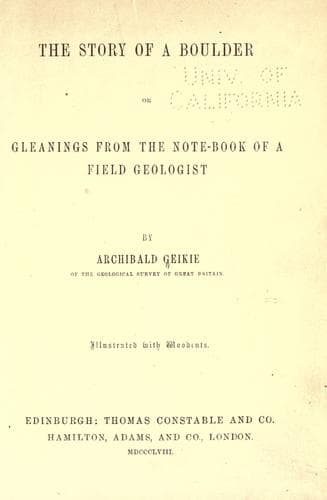
The Story of a Boulder; or, Gleanings from the Note-book of a Field GeologistGeikie, Archibald
Science
The Story of a Boulder; or, Gleanings from the Note-book of a Field Geologist
Geikie, Archibald
Geology; Petrology
In all these and similar cases, the primary cause of the waste
lies in the decomposition of the felspar. Rain-water acts in removing
the soluble portions, and the harder grains that remain, deprived of
the cementing matrix, ere long crumble down and are washed off by the
rains. In this way the rock insensibly moulders away, every frost
loosening its structure, and every shower carrying away part of its
substance.
Among the many objects of interest along a rocky coast some of the more
striking are certainly to be found in the curious and often grotesque
forms assumed by the weathered cliffs. Above high-water mark and thus
away from the dash of the waves, we can often trace the progress of
decay among such sedimentary rocks as sandstones and conglomerates.
Worn into holes and scars, projecting cusps and tapering pinnacles, or
eaten away into the rude semblance of a human form, headless perchance,
or into the shape of a huge table poised on a narrow pedestal, the
rock affords an endless variety of aspects and a continual source of
pleasure. If we chance to light upon any building constructed out of
the sandstone of such cliffs, it is worth noting that the removal of
the stone has not deprived it of its mouldering qualities; nay, that
houses erected within the memory of people still living already begin
to wear an aspect of venerable antiquity. I remember meeting with an
interesting example in the case of an old castle built on a similar
rocky coast-line. It stood on a little ness or promontory of dull red
stone, washed on all sides save one by the wild sea. The walls, of
which but a fragment remained, were built of a dark red sandstone; but
the lapse of centuries had told sadly on their masonry. The stones
rose over each other tier upon tier, corroded sometimes into holes
and hollows, sometimes into a close honey-combed surface, but the
mortar that had been used to cement them together still stood firm and
protruded from between the tiers to show, by no doubtful or ambiguous
sign, how silently yet how surely the wasting forces had been at
work. The scutcheon over the only remaining gateway had been carved
out of another kind of stone of a lighter colour and harder texture,
and so its grim lions looked nearly as fresh and formidable as when
first raised to the place of honour which they still occupied. In
this case, as before, the decomposition was owing to the presence of
a considerable proportion of soluble matter, which the rains of four
centuries had carried away along with the loosened incoherent sandy
grains.
Public-domain text, read in full here on John Shaqi.
Reviews
Reviews
No reviews yet
Be the first to share your thoughts on this work.
Elsewhere in the archive
Join the Discussion
Join the discussion
Sign in to leave a comment or review.
Sign InorCreate an account