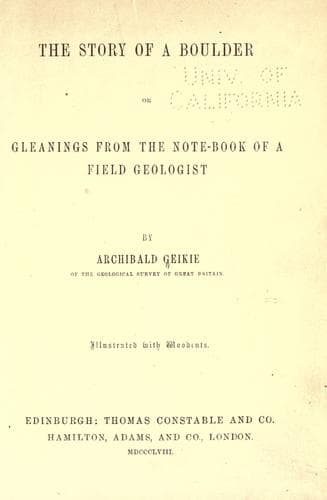
The Story of a Boulder; or, Gleanings from the Note-book of a Field GeologistGeikie, Archibald
Science
The Story of a Boulder; or, Gleanings from the Note-book of a Field Geologist
Geikie, Archibald
Geology; Petrology
across the intervening strait, lie the hills of the mainland, with
all their variety of form and outline, and all their changing tints,
as the chequered light and shade glide athwart the scene. Southward,
the eye rests on the grey wrinkled hills of Sleat, and far over along
the line where earth and sky commingle, are the mountains of Morven,
stretching westwards till they end in the bold weather-beaten headland
of Ardnamurchan, beyond which lies the blue boundless ocean. The top of
Beinn na Cailleaich is flat and smooth, surmounted in the centre by a
cairn. Tradition tells that beneath these stones there rest the bones
of the nurse of a Norwegian princess. She had accompanied her mistress
to "the misty hills of Skye," and eventually died there. But the love
of home continued strong with her to the end, for it was her last
request that she might be buried on the top of Beinn na Cailleaich,
that the clear northern breezes, coming fresh from the land of her
childhood, might blow over her grave.
I have already alluded to the wasting away of a trap-dyke. This
decomposition arises from the same cause as among the granites--the
solution, and removal of the silicates. All these trap-rocks are
igneous, and seem to have risen from below through open fissures and
rents. As they contain a large percentage of felspar--the same mineral
that gives to many granites their mouldering character--they may be
seen exhibiting every form and stage of decay. Often they stand out in
prominent relief from some cliff of soft shale, with a brown surface,
picturesquely roughened into spherical masses of all sizes, that give
to the rock somewhat the appearance of a hardened pile of ammunition
in which ponderous shells lie intermingled with round shot, grape, and
canister. Each of the concretionary balls when examined is found to
exfoliate in concentric pellicles like the coats of an onion, and you
may sometimes peal off a considerable number before arriving at the
central core, which consists of the hard rock still undecomposed. In
this case the process of degradation is aided by the decay of another
mineral called augite, which contains a variable percentage of iron,
and imparts the peculiar yellowish-brown tint to the weathered rock.
Trap-dykes may also be seen in a still more wasted condition, where,
in place of protruding from a cliff-line, they recede to some depth
and give rise to deep clefts and fissures. An instance of this kind
has been referred to in the case of the Spar Cave, and many others may
be seen along the same coast-line. The shore there for miles is formed
of a low cliff of white calcareous sandstone, fissured by innumerable
perpendicular clefts of greater or less width, and sometimes only a
yard or two apart. Each of these has once been filled by a dyke of
trap, which originally rose up in a melted state, and after having
solidified into a compact stony mass, began to yield to the process of
decay.
Public-domain text, read in full here on John Shaqi.
Reviews
Reviews
No reviews yet
Be the first to share your thoughts on this work.
Elsewhere in the archive
Join the Discussion
Join the discussion
Sign in to leave a comment or review.
Sign InorCreate an account