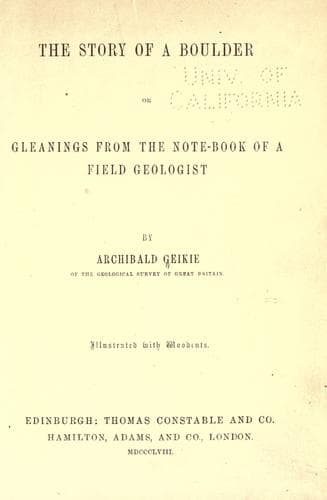
The Story of a Boulder; or, Gleanings from the Note-book of a Field GeologistGeikie, Archibald
Science
The Story of a Boulder; or, Gleanings from the Note-book of a Field Geologist
Geikie, Archibald
Geology; Petrology
Mechanical forces at work in the disintegration of rocks--Rains
Landslips--Effects of frosts--Glaciers and icebergs--Abrading
power of rivers--Suggested volume on the geology of
rivers--Some of its probable contents--Scene in a woody
ravine--First idea of the origin of the ravine one of primeval
cataclysms--Proved to be incorrect--Love of the marvellous
long the bane of geology--More careful examination shows the
operations of Nature to be singularly uniform and gradual--The
doctrine of slow and gradual change not less poetic than that
of sudden paroxysms--The origin of the ravine may be sought
among some of the quieter processes of Nature--Features of
the ravine--Lessons of the waterfall--Course of the stream
through level ground--True history of the ravine--Waves and
currents--What becomes of the waste of the land--The Rhone
and the Leman Lake--Deltas on the sea-margin--Reproductive
effects of currents and waves--Usual belief in the stability
of the land and the mutability of the ocean--The reverse
true--Continual interchange of land and sea part of the
economy of Nature--The continuance of such a condition of
things in future ages rendered probable by its continuance
during the past.
The forms of decomposition noticed in the last chapter were chiefly
of a chemical kind. Their effects were observable alike on the
surface of the earth and below ground; in the latter case we saw them
excavating caverns and long irregular chasms, in the former we noted
the production of debris which if undisturbed went to the formation
of soils. It must be borne in mind however, that in these operations
other forces than simply those of a chemical kind come into play. The
percolation of water and the removal of insoluble particles on the
exposed parts of rocks rank as mechanical processes. So also do those
by which new surfaces of mineral masses are brought within the sphere
of the chemical agencies, such as the action of frosts, rains, rivers,
and waves. In short, as already noticed, any subdivision of the forces
at work in effecting the decomposition of rocks must ever be more or
less arbitrary; but it remains nevertheless useful, if we bear in
mind that the exactly defined boundary lines are of our making, not
Nature's. With this caution we may proceed to examine what are termed
the mechanical agencies in the disintegration of mineral masses, and in
so doing, we shall find that the chemical forces are not less helpful
to the mechanical than the latter to the former.
Public-domain text, read in full here on John Shaqi.
Reviews
Reviews
No reviews yet
Be the first to share your thoughts on this work.
Elsewhere in the archive
Join the Discussion
Join the discussion
Sign in to leave a comment or review.
Sign InorCreate an account